Foam insert problems
The real problems with foam gutter inserts: water absorption, UV breakdown, crumbling into the gutter, blocked outlets, mould, ice and hidden damage.
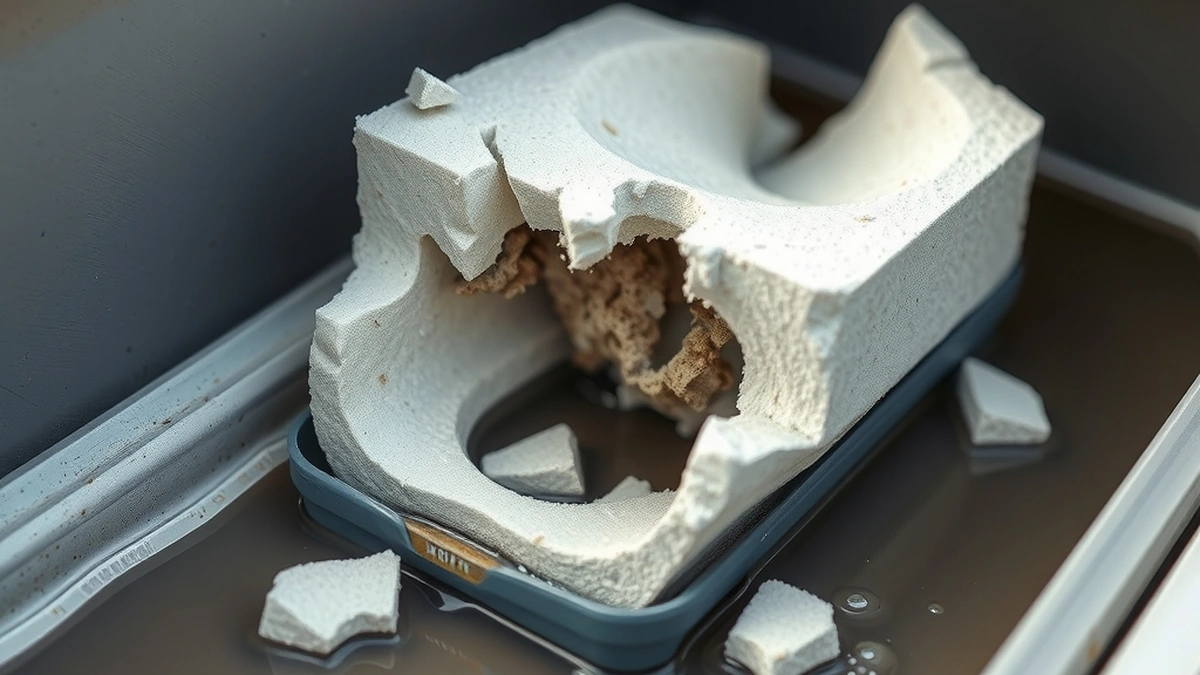
Foam inserts absorb water, break down under UV, crumble into the gutter and block outlets. Most last a few seasons at best, and the cheap open-cell products fail fastest, leaving foam granules in the trough and downspouts.
- Installed cost, 200 ft
- $200–$800
- Typical failure mode
- Waterlogging and crumble
- Cleaning per visit
- $150–$400
- Micro-mesh, same run
- $1,800–$4,500
Some links on this page are affiliate links.If you buy through them we may earn a commission at no extra cost to you. We do not accept payment for rankings. Read the full disclosure.
Foam insert problems come from the material itself, not from a bad install. Foam is porous, it sits in the wettest part of the gutter, and it is exposed to sun and freeze-thaw for its whole life. It takes on water, loses strength, breaks down at the surface and eventually crumbles into the trough it was meant to protect.
What Foam Is Up Against
A foam gutter insert is a rigid trapezoid of polyurethane or polyethylene foam that sits in the lower part of the trough, with water intended to run over its sloping top face. There is no drainage path inside it and no frame to hold its shape.
The conditions are hostile. The block is wet for days after every storm, baked by sun on the exposed face, frozen in winter and pressed by debris. At $200 to $800 installed for a typical home, it is the cheapest guard after brush inserts, and the material reflects that.
Water Absorption and Weight
Open-cell polyurethane acts like a sponge. Water enters the cell structure, the block gains weight, and it stays damp long after the gutter has drained. That dampness does two things.
First, it keeps the gutter floor wet. On steel gutter, debris held against the metal in a permanently damp state is the exact condition that drives corrosion, and the damage is invisible until rust streaks appear under the gutter.
Second, it changes the fit. A waterlogged block swells, presses harder against the gutter walls, and can bow a light aluminum section outward. When it dries it shrinks and sits loose, so water tracks down the sides instead of over the top face.
Closed-cell polyethylene resists water uptake far better, which is why the material spec matters more than the price per length. It still ages, but it does not go spongy in the first season.
UV Breakdown and Crumbling
Sunlight attacks the exposed top face. The surface oxidizes, goes chalky, then crazes and starts to shed material. What sheds is foam granules, and they land in the gutter.
Once crumbling starts, the block loses its shape and its fit at the same time. The top face pits, water pools in the depressions, and the debris that was supposed to slide off now sticks. From that point the product is actively making the gutter worse: it is shedding material into the trough and holding water against the floor.
Debris Still Gets In
Foam does not filter. It displaces the lower part of the trough so leaves rest on the sloping face, but anything narrow that reaches the gutter opening still enters, and anything that lands on the face and breaks down washes in with the next rain.
The result is a shallow gutter with a foam block in it and a silt layer building around the block’s edges. Pine needles, shingle grit, catkins and seed pods all behave this way. The product suits coarse broadleaf debris on a short run and nothing more.
Flow and Outlet Problems
A foam block occupies a large share of the trough cross-section. On a normal rain this is fine. In a downpour the block throttles flow, and water backs up the run to the lowest point, which is usually a corner or the outlet.
The outlet is the second failure. A block cut across an outlet dams the run outright, and a block cut back correctly still sheds granules that migrate to the same place. Both failures look identical from the ground: water over the front lip at the low point.
That is also why the downspout blockage prevention checklist starts at the elbow, not at the guard. Foam granules pack into the elbow and set, and no amount of surface clearing will shift them.
Mould, Insects and Ice
A damp, porous block in a warm gutter is a growth medium. Algae and mould colonize the surface, and the dark damp space underneath is shelter for ants, spiders and wasps.
In winter the trapped water freezes. Ice bonded into the foam expands, and repeated freeze-thaw cycles push the block up and out of the trough. Lifted sections leave gaps at the ends and at corners, and the gaps feed debris straight past the guard.
| Symptom | Likely cause | What to check |
|---|---|---|
| Foam feels heavy and spongy | Open-cell foam waterlogged | Squeeze a section; water should not run out |
| Granules in the trough | UV breakdown of the top face | Surface pitting and chalky residue |
| Water over the lip in storms | Block throttling flow | Outlet and lowest point of the run |
| Block lifted at one end | Ice expansion or debris pressure | Section ends and corners |
| Rust streaks below the gutter | Damp debris held on steel | Floor under the block |
| Mould or algae on the face | Standing water and shade | Pitch along the run |
What to Do About It
- Lift a section and squeeze it. If water runs out, the material is open-cell and waterlogged, and it will not recover.
- Clear every trace of crumbled foam from the trough, the outlet and the downspout elbows before fitting anything else.
- Check the gutter floor for rust and the hangers for sag while the trough is open.
- Switch to closed-cell foam, a brush insert or a mesh panel, depending on the debris load.
- If needles or grit are present, skip the insert category entirely and price a mesh system at $1,800 to $4,500.
The foam insert maintenance page covers the inspection routine for a block that is still intact, and foam insert cost shows what replacement costs per foot. For the comparison that matters, see brush insert vs micro-mesh and gutter guard repair for the damage a failed insert can hide.
Bottom Line
Foam insert problems are structural, not occasional: the material absorbs water, degrades in UV, crumbles into the gutter and throttles flow at exactly the moment flow matters. At $200 to $800 installed it is priced as a short-lived barrier, and it should be bought and replaced on that basis. If the run matters enough to guard, closed-cell foam or a brush insert is the more honest cheap option, and a mesh system is the one that stops the debris foam lets through.
Frequently asked questions
Why do foam gutter inserts fail?
Foam is porous, and open-cell polyurethane in particular takes on water, holds it against the gutter, and loses structural strength as it cycles wet and dry. UV exposure breaks the surface down further, and the block begins to crumble.
How long do foam gutter inserts last?
Shorter than brush or mesh guards. Open-cell foam can degrade within a few seasons, and closed-cell foam lasts longer but still breaks down under sustained sun and standing water. The material is a consumable, not a permanent fixture.
Do foam inserts clog the downspout?
They can. Crumbling foam sheds granules that wash into the outlet and pack into the downspout elbow, and a block fitted across an outlet will dam water outright. Both failures show up as overflow at the lowest point of the run.
Do foam inserts hold water?
Yes, especially open-cell foam. The block sits in the bottom of the trough where water collects, so it stays damp long after the rain stops, which keeps the gutter floor wet and accelerates corrosion on steel.
Is foam better than brush for gutters?
Generally no. A brush insert can be lifted, rinsed and reused, and it does not crumble into the gutter. Foam is cheaper per unit and easier to cut, but it is replaced rather than maintained.
What should I do if foam is already crumbled in my gutter?
Clear it out completely, including the granules in the trough and the downspout elbows, before fitting anything else. Foam residue left behind will block the outlet again and can trap debris against the gutter floor.
Sources
Some links are affiliate links.If you buy through them we may earn a commission at no extra cost to you. We do not accept payment for rankings. Read the full disclosure.