Foam insert cost
What foam gutter inserts cost per linear foot and per job, how polyurethane and closed-cell foam differ, and why the cheap price hides a short life.
Foam gutter inserts cost $200 to $800 installed on a typical home, or $1.00 to $4.00 per linear foot over 200 feet. The material is cheap; shaping trapezoid sections and fitting corners is where the labor goes.
- Installed, 200 ft
- $200–$800
- Cost per linear foot
- $1.00–$4.00
- Brush inset, same run
- $200–$800
- Micro-mesh, same run
- $1,800–$4,500
Some links on this page are affiliate links.If you buy through them we may earn a commission at no extra cost to you. We do not accept payment for rankings. Read the full disclosure.
Foam gutter inserts cost $200 to $800 installed on a typical home, which is $1.00 to $4.00 per linear foot on a 200-foot run. That puts them in the same band as brush inserts and roughly a fifth of a micro-mesh system. The material is not what you are paying for; the shaping and fitting is.
What the Price Includes
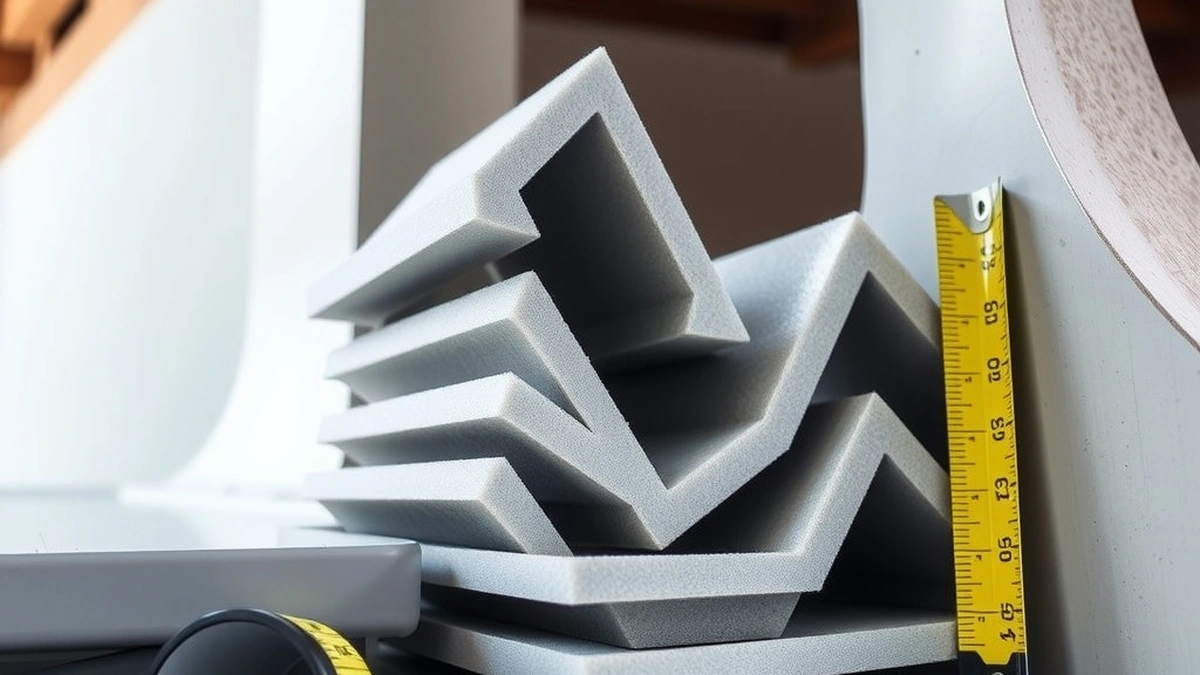
A foam gutter insert is a trapezoid or triangular block of foam, sized to sit in the trough below the gutter lip, with water intended to run over the top and into the downspout while leaves rest on the sloping face. It is not a filter and does not strain water.
The price band matches the other insert products. Brush or foam inserts installed run $200 to $800. A DIY screen runs $300 to $900. Micro-mesh runs $1,800 to $4,500, reverse-curve $2,000 to $5,000, and dealer systems $3,000 to $8,000. One professional cleaning is $150 to $400.
Cost per Linear Foot
Work it out per run rather than per house, because the number moves.
- 200-foot run: $200 ÷ 200 = $1.00 per foot; $800 ÷ 200 = $4.00 per foot.
- 120-foot run: $200 ÷ 120 = $1.67 per foot; $800 ÷ 120 = $6.67 per foot.
- 300-foot run: $200 ÷ 300 = $0.67 per foot; $800 ÷ 300 = $2.67 per foot.
The pattern is the same as every small trade job: there is a floor cost for showing up, buying material and disposing of debris, and it does not shrink with the run. A three-bedroom ranch with 120 feet of gutter will be quoted closer to the per-foot ceiling than a long single-story run will.
Foam Types and Relative Cost
| Foam type | Behavior in a gutter | Relative material cost |
|---|---|---|
| Open-cell polyurethane | Absorbs water, stays damp, breaks down fastest | Lowest |
| Closed-cell polyethylene | Resists water uptake, holds shape longer | Middle |
| Coated or skinned foam | Surface sheds water, core still degrades | Highest |
The cheap open-cell product is the one most often sold in hardware stores and online, and it is the one that produces the complaints covered in foam insert problems. Closed-cell foam costs more per length and lasts longer, and the coated products add a skin that delays UV breakdown without preventing it.
Pay for closed-cell if you buy at all. The difference in material price is small next to the labor of fitting it, and replacing cheap foam twice costs more than buying the better product once.
What Pushes a Quote Up
Height is the main driver. A two-story run needs ladders or stands, and OSHA fall-protection rules govern work above six feet, which adds time to every foot.
Corners and hanger straps are the second driver. Foam cannot be bent, so every inside and outside corner becomes a mitre cut, and every hanger strap that crosses the trough has to be notched or worked around. A run with six corners and exposed straps can take twice the labor of a clean straight span.
Gutter condition sets a floor. A trough full of wet leaves has to be emptied before foam goes in, and a gutter holding standing water has to have its pitch addressed, or the foam sits in a puddle and wicks it up.
DIY Material Versus Installed
Buying the foam yourself and cutting it in is the cheapest version of the job, and on a single-story run it is genuinely a homeowner task.
Measure the inside width of the trough at the top, the depth to the gutter floor, and the length of each run. Cut the trapezoid so the top face sits just below the gutter lip, not above it. Cut mitres at corners and notch around outlets.
What you save is labor and travel. What you give up is the pre-clear, the debris disposal and an experienced eye on the gutter while it is open. On a single story with clean gutters that is a fair trade; on a two-story house with a valley dumping onto the run it is not.
The Arithmetic Over Time
The purchase price is only the first number.
- One installed set: $200 to $800.
- Two cleanings a year at $150 to $400: $300 to $800 annually.
- A foam set that has to be replaced because it has crumbled or gone waterlogged: another $200 to $800, plus the labor again.
Set against a micro-mesh system at $1,800 to $4,500 that needs only surface clearing, the foam looks cheap once and expensive twice. Set against doing nothing and paying for cleanings, it looks like a modest convenience at a modest price. Both readings are honest; the mistake is assuming the foam removes the cleaning line permanently.
Before You Commit
- Measure the trough width and depth, and confirm a trapezoid section actually fits without bowing the gutter walls.
- Check the material spec for closed-cell construction and UV stabilization, and reject anything described only as sponge or foam rubber.
- Count corners and hanger straps, since each one adds a cut and a fitting step.
- Compare the installed total with two cleanings a year at $150 to $400, the cost it is meant to offset.
- Look at the price of a brush insert at the same $200 to $800, because it lifts out and can be rinsed, which foam cannot.
For the fitting detail see foam insert installation, and for the wider budget see gutter guard cost and brush insert cost.
Bottom Line
Foam insert cost sits at $200 to $800 installed, or $1.00 to $4.00 per linear foot on 200 feet, and the number is low because the product is a block of foam rather than a framed system. It does not filter water, it does not stop needles, and it degrades faster than either brush or mesh. Buy it as a cheap, short-lived barrier on a small single-story run, and price closed-cell foam rather than the open-cell product that gives the category its reputation.
Frequently asked questions
How much do foam gutter inserts cost?
Installed, expect $200 to $800 on a typical home, the same band as brush inserts and roughly a fifth of a micro-mesh system at $1,800 to $4,500. Material alone can be had for well under half of that.
What is the cost per linear foot?
On a 200-foot run, $200 to $800 is $1.00 to $4.00 per linear foot. On a 100-foot run the same total is $2.00 to $8.00 per foot, because the minimum charge and travel are spread over fewer feet.
Why does foam cost the same as brush if it is cheaper material?
Foam has to be cut to the trough profile, fitted around hangers and shaped at corners, and it is sold in rigid lengths that waste material at every turn. The labor is what puts it in the same price band.
Is foam or brush cheaper to maintain?
Foam is usually worse. It absorbs water, breaks down under UV and crumbles into the gutter, so it is replaced rather than cleaned. Brush inserts can be lifted, rinsed and reused for a few seasons.
Can I buy foam inserts and cut them myself?
Yes, and that is the cheapest route at material cost only. The catch is that the trapezoid has to match the trough width and depth closely, because a loose fit lets water run past the sides and a tight fit bows the gutter.
Do foam inserts save money over professional cleaning?
Rarely. Two cleanings a year at $150 to $400 is $300 to $800, the same as the installed price of the foam, and the foam still has to be inspected and usually replaced within a few seasons.
Sources
Some links are affiliate links.If you buy through them we may earn a commission at no extra cost to you. We do not accept payment for rankings. Read the full disclosure.