Screen problems: the five failures and what they cost
Clogging, sagging, back-edge gaps, corrosion, and ice bridging are the five common screen gutter guard failures. What each looks like and what the repair costs.
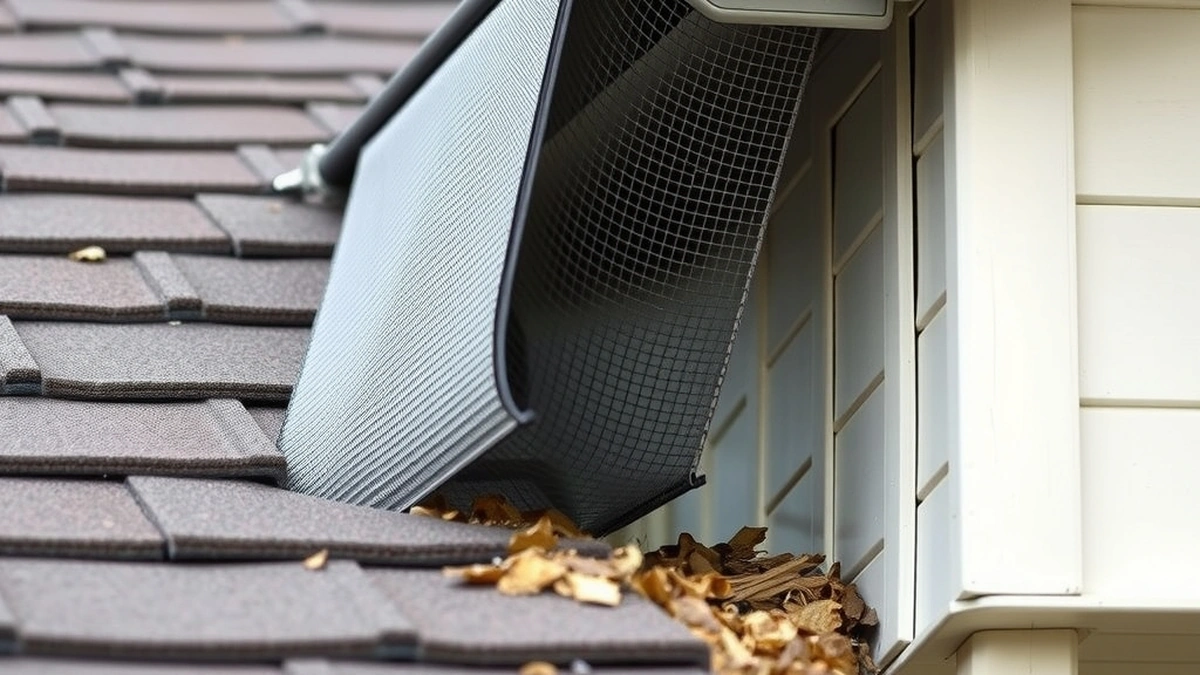
Screen guards fail by clogging at the surface, sagging between hangers, leaving a gap at the back edge, corroding, or bridging with ice. Repairs run from $150 to $400 for a clean-out up to $900 for a full re-screen, and hanger work adds $6 to $12 per foot.
- Clean-out
- $150 - $400
- Hanger or fascia repair
- $6 - $12 per linear foot
- Full re-screen
- $300 - $900
- Typical service life
- 5 - 10 years
Some links on this page are affiliate links.If you buy through them we may earn a commission at no extra cost to you. We do not accept payment for rankings. Read the full disclosure.
Screen guards fail in five predictable ways, and the repair bill ranges from $150 to $400 for a clean-out to $900 for a full re-screen on a typical house. None of the failures is mysterious: each comes from a specific mismatch between the product, the gutter it sits on, and the debris the roof produces. Knowing which one you have decides whether you spend an afternoon with a hose or replace the run.
The five failures at a glance
| Problem | What you see | Cause | Typical fix | Cost |
|---|---|---|---|---|
| Surface clog | Water sheeting over the front | Grit and pollen packed into perforations | Lift and wash panels | $150 - $400 |
| Sagging | Screen dips between hangers | Wide hanger spacing, soft lip | Re-hang or add supports | $6 - $12 per ft |
| Back-edge gap | Debris under the panel | Panel cut narrow or lifted | Re-cut and fasten rear edge | $1.50 - $4.50 per ft |
| Corrosion | White powder, pitting, rust streaks | Dissimilar metals, trapped moisture | Replace affected sections | $300 - $900 |
| Ice bridging | Solid ridge over the gutter | Meltwater refreezing at the lip | Remove load, improve drainage | $150 - $400 |
The costs are estimates for a single-storey house and move with access and height. Across all five, the product is rarely the whole story; the gutter underneath it usually is.
Surface clogging
A screen is a barrier with holes. Leaves stay on top and blow away, which is the design working. The problem is the fraction of debris small enough to pass through the holes but large enough to be caught by the next layer: shingle grit, bud scales, pollen, and the fines that come off a weathered roof.
Once that material wets and dries a few times, it forms a felt-like mat. Water then runs across the mat instead of through it, and the gutter behaves as if it has no guard at all, except that the overflow now starts at the front lip rather than the end.
Rinsing from above clears it temporarily. The durable fix is a finer aperture, or a schedule that assumes the screen gets cleaned twice a year.
Sagging and the back-edge gap
A screen has almost no stiffness of its own. It relies on the gutter lip at the front and the hanger or fascia at the back, and on hangers being close enough together that the span between them does not deflect.
Most residential hangers are spaced 24 to 36 inches apart. Over a five-inch gutter that is a long unsupported span for a light aluminium sheet, and a wet snow load or a ladder leaned in the wrong place finishes the job. The screen bows, water pools in the dip, and the fasteners at the low point tear out of the lip.
The repair is mechanical: add hanger brackets at 24-inch centres, replace torn fasteners with larger self-tappers, and support the panel at midspan. Where the lip is already distorted, a fascia bracket carries the load into the board instead.
The back-edge gap is the failure that does the most hidden damage. A panel fastened only along the front lip can lift at the back, especially on a roof with a shallow pitch where wind gets under the leading edge. The gap is narrow enough to look closed from the ground and wide enough to pass every leaf on the roof.
Debris then enters unseen, so cleaning is deferred until the gutter overflows or the fascia rots. By the time the guard is lifted, the trough is worse than an unguarded one would have been.
Fix it by fastening the rear edge to the fascia with a bracket, or under the last shingle course with a formed lip that does not lift the shingle. Cutting the panel to the true width, measured inside the lip return, prevents the gap.
Corrosion and staining
Two different problems get called rust. The first is the screen itself corroding, which happens with uncoated steel mesh in a wet, coastal, or fertiliser-heavy environment. The second is the gutter corroding underneath, which shows as white aluminium oxide powder or brown streaks below the lip.
Both are accelerated by trapped debris. A screen holding wet organic matter keeps the gutter damp, so the metal loses the dry cycle that slows corrosion, and a galvanised screen on an aluminium gutter adds a galvanic couple whenever water connects them. Replacement is the fix once pitting starts; cleaning and coating a gutter that has lost its surface is a delay, not a repair.
Ice bridging
In a cold climate, meltwater reaches the gutter, freezes at the front lip, and builds a ridge that closes the opening. The ridge forms on top of the screen, so the guard is not at fault. Once solid, further meltwater backs under the roof covering and appears indoors as a leak.
Clear the ridge without hammering the gutter. The durable fix is reducing the heat loss that causes the melt, which is attic insulation and ventilation work rather than a guard problem.
Diagnosing in six steps
- Look at the run from the ground in rain, not in dry weather. Overflow location tells you which end is failing.
- Lift one panel at a corner and check whether debris is on top of the screen or underneath it.
- Push down on the screen mid-span. More than half an inch of deflection means the hanger spacing is too wide.
- Check the back edge with a torch. Any visible gap is a debris path.
- Look for white powder, rust streaks, or pitting at the lip and on the panel.
- Measure the fall with a level before buying anything. A backwards-pitched gutter mimics every screen failure.
What a repair costs
On a 200-foot house, a clean-out at $150 to $400 is the cheapest outcome and the most common. Hanger and fascia work at $6 to $12 per foot runs $1,200 to $2,400 across the full run, which is why it is usually done only where the sag is. A full re-screen at $300 to $900 in material is the point where replacement beats patching.
Divide by the years you expect to keep the house. A $400 clean-out every year is $4,000 over a decade, more than a micro-mesh installation at $1,800 to $4,500 that needs no annual lifting. That comparison is in screen vs micro-mesh; replacement pricing is in micro-mesh cost.
The short version
Screen problems are mostly installation problems wearing a product costume. Clogging is a design limit, but sagging, back-edge gaps, and corrosion are all downstream of hanger spacing and fastening. Fix the gutter first, then decide whether the screen deserves to go back on.
If the run needs re-screening for the second time, the money is better spent on a framed mesh system. The per-foot arithmetic is in gutter guard cost, and the maintenance routine that keeps any screen alive longer is covered in screen maintenance.
Frequently asked questions
Why does my screen guard keep clogging?
The perforations are large enough to pass grit and pollen but small enough to catch them once they wet and pack. The mat that forms is a surface clog, and it is the most common reason a screen stops draining.
Why is my gutter screen sagging?
Either the hangers are spaced too far apart, the screen is unsupported across a wide gutter, or the fasteners pulled out of a soft aluminium lip. Snow load and ladder pressure accelerate it.
Can a screen guard cause rust?
A steel screen on an aluminium gutter creates a galvanic pair when water bridges the two metals, and the aluminium pits. Trapped debris also holds moisture against the gutter floor, which speeds corrosion on any metal.
How much does it cost to fix a screen guard?
A professional clean-out is $150 to $400. Replacing the screen on a 200-foot house is $300 to $900 in material. If the hangers or fascia need work, add $6 to $12 per linear foot.
Why is there a gap at the back of my gutter screen?
The panel was cut narrow, or it was fastened only at the front lip and has lifted. Debris drops straight through that gap, which is worse than having no screen because it hides the problem.
Should I repair or replace a screen guard?
Repair if the panels are sound and the failure is fastening or debris. Replace when the mesh is torn, the coating is gone, or more than a quarter of the run has pulled loose, because patching a failing system rarely lasts.
Sources
Some links are affiliate links.If you buy through them we may earn a commission at no extra cost to you. We do not accept payment for rankings. Read the full disclosure.