Screen maintenance: the twice-yearly routine that works
What screen gutter guards need to keep draining, what a paid clean-out costs at $150 to $400, and the checks that stop a cheap screen failing early.
Screen maintenance is two clean-outs a year, one after leaf fall and one after spring pollen, plus a fastening check each time. Doing it yourself costs nothing but ladder time; a paid clean-out runs $150 to $400 per visit.
- DIY clean-out
- Free, 1 - 3 hours
- Paid clean-out
- $150 - $400 per visit
- Frequency
- Twice a year
- Replacement trigger
- Torn mesh or loose panels
Some links on this page are affiliate links.If you buy through them we may earn a commission at no extra cost to you. We do not accept payment for rankings. Read the full disclosure.
Screen maintenance is two clean-outs a year and a fastening check each time, and it costs either a few hours of ladder work or $150 to $400 per visit if you pay someone. That is the whole routine. The reason screens get a reputation for failing is that most are never touched after installation, and a screen that is never cleaned stops draining within two seasons.
What maintenance a screen actually needs
A screen guard is a perforated barrier over the gutter opening. Maintenance means removing what accumulates on top before it packs into the holes, confirming the panel is still fastened at both edges, and making sure water can still reach the downspout.
That is a different job from cleaning an open gutter. You are not scooping a trough; you are keeping a filter surface permeable. The distinction matters because the tools and the failure modes are different.
What it costs, with the arithmetic
| Task | DIY | Paid |
|---|---|---|
| Full clean-out | $0 plus 1 - 3 hours | $150 - $400 per visit |
| Twice-yearly total | $0 | $300 - $800 per year |
| Re-fastening a section | Under $20 in screws | $6 - $12 per linear foot |
| Full re-screen, 200 ft | $300 - $900 | $1,200 - $2,700 |
The annual paid figure is the per-visit range doubled: $150 × 2 = $300, and $400 × 2 = $800. Over ten years that is $3,000 to $8,000, which is the same order as a framed micro-mesh installation at $1,800 to $4,500. On a heavy-debris property, paying to maintain a cheap screen for a decade costs more than replacing it once with a product that needs less attention.
The twice-yearly routine
- Wait for dry weather. Wet debris smears and packs; dry debris brushes off.
- Work from a stable ladder with a standoff, and never stand above the top rung to reach a panel edge.
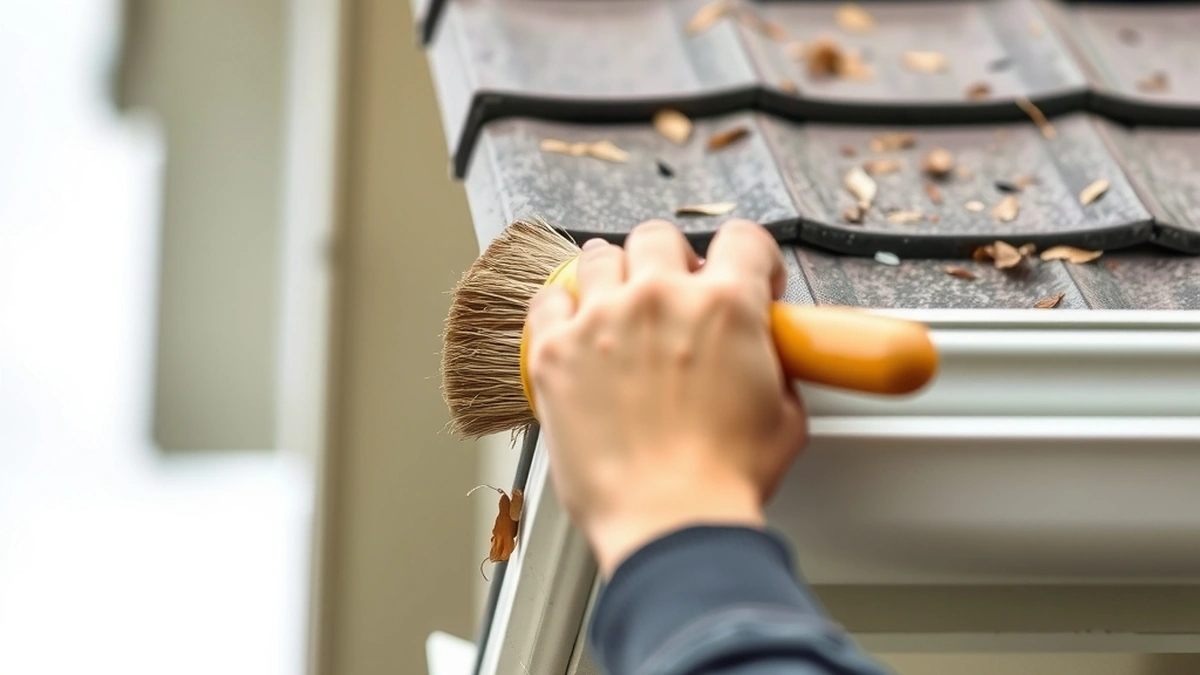
- Brush the screen from the ridge down toward the gutter, using a soft hand brush rather than a stiff yard broom.
- Rinse with a hose at low pressure, running water along the panel rather than blasting across it.
- Lift the first and last panel and check the trough underneath. Debris there means the back edge is open.
- Check fasteners at each end and at every hanger, and tighten or replace anything loose.
Five minutes on step six prevents most of the overflow complaints that get blamed on the product. A screen that has lifted two inches at the back is worse than no screen, because it hides the debris it lets in.
Cleaning without damaging the panel
The temptation is a pressure washer, because it is fast. It is also the fastest way to ruin the job. A narrow jet at close range bends the mesh, lifts the front lip, strips the coating off a painted panel, and drives grit through the perforations into the gutter where it becomes a sludge that blocks the outlet.
Use a garden hose with a spray nozzle on a fan setting, directed along the run. If the mat is stubborn, wet it, wait ten minutes, and brush again. For pollen that has baked on, a dilute dish soap solution and a soft brush will lift it without abrading the coating.
Never walk on a screen. A panel spanning a five-inch gutter will not carry an adult’s weight, and the deformation it takes is permanent. If a section needs hands-on work, lift it out.
What shortens a screen’s life
- Debris left in place. Wet organic matter holds moisture against the metal and accelerates corrosion at the contact points.
- Loose fasteners. A panel that moves wears through its coating at the screw holes, and that is where rust starts.
- Ladder pressure. Leaning a ladder directly on the gutter lip deforms both the gutter and the screen. A standoff costs less than a replacement section.
- Dissimilar metals. A galvanised steel screen on an aluminium gutter creates a galvanic couple wherever water bridges them.
- Tree sap and bird droppings. Both are acidic and both etch a coated surface if left through a season.
- Ice. A ridge that forms at the lip and is then hammered off takes the coating with it.
Repair or replace
| Condition | Action | Cost |
|---|---|---|
| Surface mat only | Clean | $0 - $400 |
| One or two loose panels | Re-fasten | Under $50 |
| Torn mesh on one section | Replace section | $10 - $50 |
| Sagging over half the run | Add hangers, then re-screen | $6 - $12 per ft plus material |
| Coating gone, pitting visible | Replace the run | $300 - $900 |
The rule of thumb: if more than a quarter of the run has failed, replace the whole thing. Patchwork on a system that is already at the end of its coating life buys a season and costs a second ladder day.
The yearly calendar
Late autumn, after the leaves are down, is the important one. That clean-out removes the load that would otherwise sit wet through winter and freeze into the gutter. Spring, after pollen and seed drop, is the second. In pine country, add a mid-summer pass because needles work into the perforations and do not blow off.
If the house is two storeys, or the roof pitch is steep, the arithmetic favours paying. Two visits at $150 to $400 is $300 to $800 a year, and that is cheaper than the fascia repair that follows a season of undetected overflow. The wider cost picture is in screen cost, and the failures to watch for between visits are covered in screen problems.
Where the money goes instead
If the annual clean-out is becoming a fixed cost, the alternative is a framed mesh panel that sheds debris rather than trapping it. Micro-mesh runs $1,800 to $4,500 installed, needs brushing rather than lifting, and is expected to last ten to fifteen years against five to ten for a coated screen. The per-foot comparison is in screen vs micro-mesh, and the installation method is in gutter guard installation.
Frequently asked questions
How often should gutter screens be cleaned?
Twice a year in most of the US: once in late autumn after leaf fall and once in spring after pollen and seed drop. A house under pines needs a third pass in mid-summer.
How much does screen maintenance cost?
Nothing if you do it, beyond an hour or three on a ladder. A professional clean-out is $150 to $400 per visit, so twice a year is $300 to $800 annually.
Can I pressure wash gutter screens?
Only on a low setting and never straight down into the mesh. A narrow jet lifts the edges, strips coatings, and drives debris into the gutter instead of off it. A hose and a soft brush are safer.
What should I check besides debris?
Fasteners, the back edge, the downspout outlets, and the gutter pitch. Loose screws and open back edges cause more overflow than a dirty screen does.
How long do screen guards last?
Five to ten years for a coated aluminium screen that is cleaned and left fastened. Uncoated steel in a wet climate can fail in three, and a screen that is walked on will not last a season.
Is it worth paying someone to clean screens?
On a two-storey house, usually yes. The $150 to $400 visit buys ladder safety and insurance, and the annual $300 to $800 still undercuts replacing a rotted fascia board.
Sources
Some links are affiliate links.If you buy through them we may earn a commission at no extra cost to you. We do not accept payment for rankings. Read the full disclosure.