Gutter guard cost
One-page cost reference for every guard type, how the total scales with house size, and the four variables that move a quote off the list price.
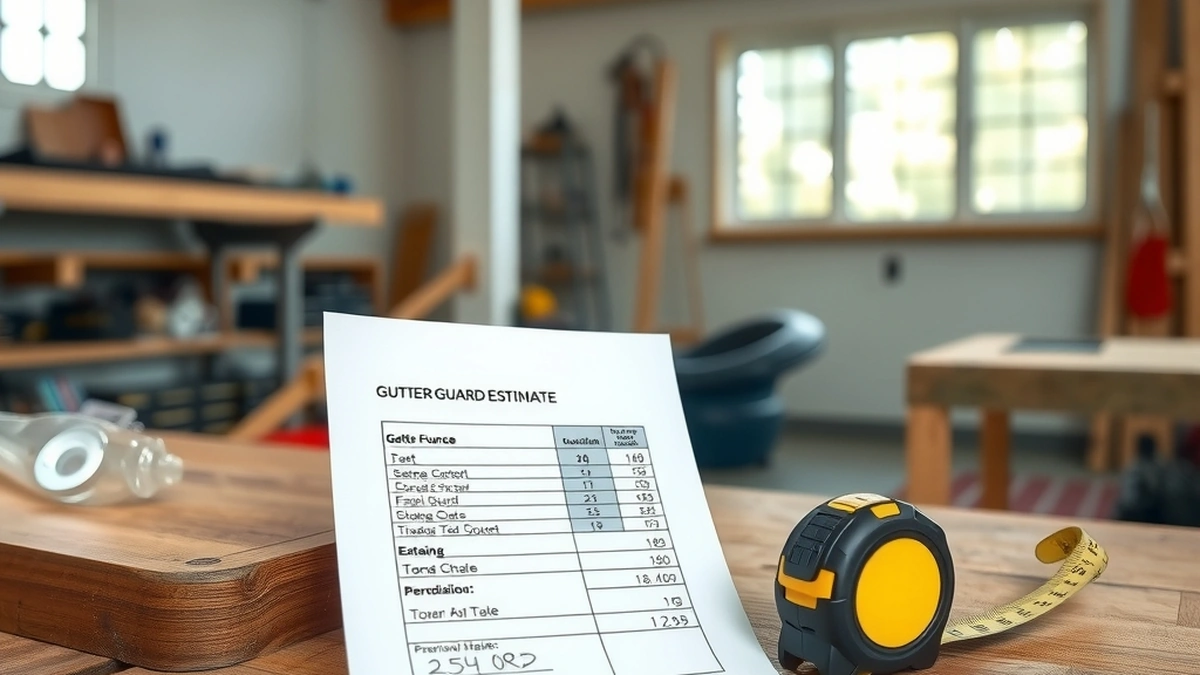
Gutter guard cost runs $1,800 to $4,500 installed for micro-mesh, $2,000 to $5,000 for reverse curve, $3,000 to $8,000 for dealer systems, and $200 to $900 for DIY inserts or screens. Cleaning costs $150 to $400 a visit.
- Micro-mesh, installed
- $1,800–$4,500
- Reverse curve, installed
- $2,000–$5,000
- Dealer-brand system
- $3,000–$8,000
- DIY inserts or screens
- $200–$900
Some links on this page are affiliate links.If you buy through them we may earn a commission at no extra cost to you. We do not accept payment for rankings. Read the full disclosure.
Gutter guard cost runs from about $200 for a set of foam inserts to $8,000 for a dealer-installed branded system, and the gap is explained by three things: material, labor, and how the product is sold. Installed micro-mesh sits at $1,800 to $4,500, which is where most homeowners end up. What follows is the price structure, the arithmetic per house size, and the four variables that move a quote off the published range.
The Numbers First
Every figure below is an installed estimate for a typical single-family home, and every one of them is a range because quotes legitimately differ by region and roof.
| Product | Installed cost (estimate) | Per foot on 200 ft |
|---|---|---|
| Brush or foam insert | $200–$800 | $1.00–$4.00 |
| DIY screen guard | $300–$900 | $1.50–$4.50 |
| Micro-mesh | $1,800–$4,500 | $9.00–$22.50 |
| Reverse curve | $2,000–$5,000 | $10.00–$25.00 |
| Dealer-brand system | $3,000–$8,000 | $15.00–$40.00 |
The arithmetic is plain division: $1,800 ÷ 200 = $9.00, and $4,500 ÷ 200 = $22.50. Use the per-foot column to compare quotes for houses of different sizes, and the total column to set a budget.
What Each Price Band Buys
Under $1,000 you are buying a consumer product: foam inserts, brush strips, or roll-out screening that clips to the gutter lip. These work on light debris, need frequent clearing, and last a few years. The installation is yours, including the ladder work.
The $1,800 to $5,000 band is contractor territory. Micro-mesh and reverse curve are fitted to the gutter profile, cut at corners, fastened through the lip or fascia, and backed by a workmanship warranty. This is the band where the product is designed to survive a decade or more.
Above $5,000 you are usually buying a dealer system, where the price includes an in-home consultation, a factory warranty, and a service network. The material is broadly similar to the mid band. What differs is who answers the phone in year eight and whether the warranty transfers when you sell. Our leaf filter cost breakdown covers that premium in detail.
Cost by House Size
Linear footage, not floor area, sets the price. A 1,400-square-foot ranch with a long perimeter can carry more gutter than a 2,400-square-foot two-story with a compact footprint.
| Gutter length | Micro-mesh at $9/ft | Micro-mesh at $22.50/ft | Dealer at $15–$40/ft |
|---|---|---|---|
| 120 ft | $1,080 | $2,700 | $1,800–$4,800 |
| 150 ft | $1,350 | $3,375 | $2,250–$6,000 |
| 200 ft | $1,800 | $4,500 | $3,000–$8,000 |
| 250 ft | $2,250 | $5,625 | $3,750–$10,000 |
The 120-foot row shows why small jobs cost more per foot in practice: fixed mobilization costs get spread over less material, so contractors often quote the low-footage job above the per-foot rate implied by the table. Expect to pay a minimum job charge on anything under about 100 feet.
The dealer column runs past the typical $3,000 to $8,000 band at the top end, because a 250-foot house priced at the highest per-foot rate lands above it. Read that as the arithmetic doing what arithmetic does, not as a quote: dealer pricing is set in the home, and most jobs land inside the band.
The Cleaning Baseline
Guards are usually justified against cleaning, so keep the comparison figure in view. Professional gutter cleaning costs $150 to $400 per visit. Twice a year is $300 to $800, and ten years is $3,000 to $8,000.
That range overlaps the installed price of nearly every guard on the market, which is why the decision cannot be made on price alone. It has to be made on how much cleaning you actually pay for and whether the work is something you would do yourself. A homeowner who cleans their own single-story gutters twice a year has an annual cleaning cost of zero dollars and a guard purchase that never pays back on arithmetic.
Why Two Quotes for the Same House Differ
Four variables account for most of the spread between quotes on identical houses:
- Roof height. Second and third stories need taller access, more setup time, and often a lift. Labor can double.
- Roofline complexity. Valleys, dormers, and short runs mean more cutting, more waste, and more fastening points.
- Existing conditions. Old guard removal, sagging gutter, and soft fascia all add work before the new product goes on.
- Scope wording. One quote includes pre-install cleaning and disposal; the other excludes both. The gap is often the excluded items rather than the guard.
A fifth variable is who is selling. Dealer quotes include a sales visit and a warranty administration cost that a local contractor does not carry, which is why the same material appears at $4,000 from one and $7,500 from another.
How to Price Your Own Job
- Measure each gutter run end to end in feet and add them up, including porches and garage runs.
- Decide which product class fits your debris: coarse leaves only, or needles and grit as well.
- Note the number of stories and any run you cannot safely reach.
- Get three written quotes that state footage, product, and inclusions.
- Divide each total by your footage to get a per-foot price, then compare.
- Add the excluded items back in, so the quotes are compared on the same scope.
Run the payback as a final check: divide the installed total by your annual cleaning spend. Under eight years is a reasonable purchase; past fifteen, you are buying convenience. Our is gutter guard worth it page runs that math with worked examples, and gutter guard installation cost explains what the labor portion covers.
Bottom Line
Gutter guard cost ranges from $200 to $8,000, with installed micro-mesh at $1,800 to $4,500, reverse curve at $2,000 to $5,000, and dealer systems at $3,000 to $8,000. Divide every quote by linear footage, confirm what is excluded, and compare against $150 to $400 per cleaning. Buy in the mid band for the best material-to-price ratio, and skip guards entirely if cleaning is cheap and you are willing to do it. For the full product-by-product breakdown, see how much does gutter guard cost.
Frequently asked questions
How much do gutter guards cost?
Installed systems run $1,800 to $8,000 depending on product and house size. DIY screens cost $300 to $900 and brush or foam inserts $200 to $800.
What is the average gutter guard cost for a 200-foot house?
At 200 linear feet, installed micro-mesh usually lands between $1,800 and $4,500, which is roughly $9 to $22.50 per linear foot.
Is it cheaper to install guards on a new gutter?
Yes, marginally. The crew is already on ladders and the gutter is empty, so you avoid a second mobilization charge even though material costs are unchanged.
Do gutter guards cost less in winter?
Availability improves outside the fall leaf season, and some contractors price more keenly in slow months, but there is no reliable seasonal discount.
What is the cheapest gutter guard that still works?
DIY screen guards at $300 to $900 handle large leaves on a one-story house. They do not stop pine needles, so they are a poor fit under conifers.
How does guard cost compare with cleaning?
Cleaning is $150 to $400 per visit, so two visits a year is $300 to $800. Over ten years that is $3,000 to $8,000, which overlaps the installed price range.
Sources
Some links are affiliate links.If you buy through them we may earn a commission at no extra cost to you. We do not accept payment for rankings. Read the full disclosure.