Ice dams: warning signs before the ceiling stains
Icicles, an ice ridge at the eave, and frost on the deck are early ice dam signs. What each means, when water is already inside, and what to check first.
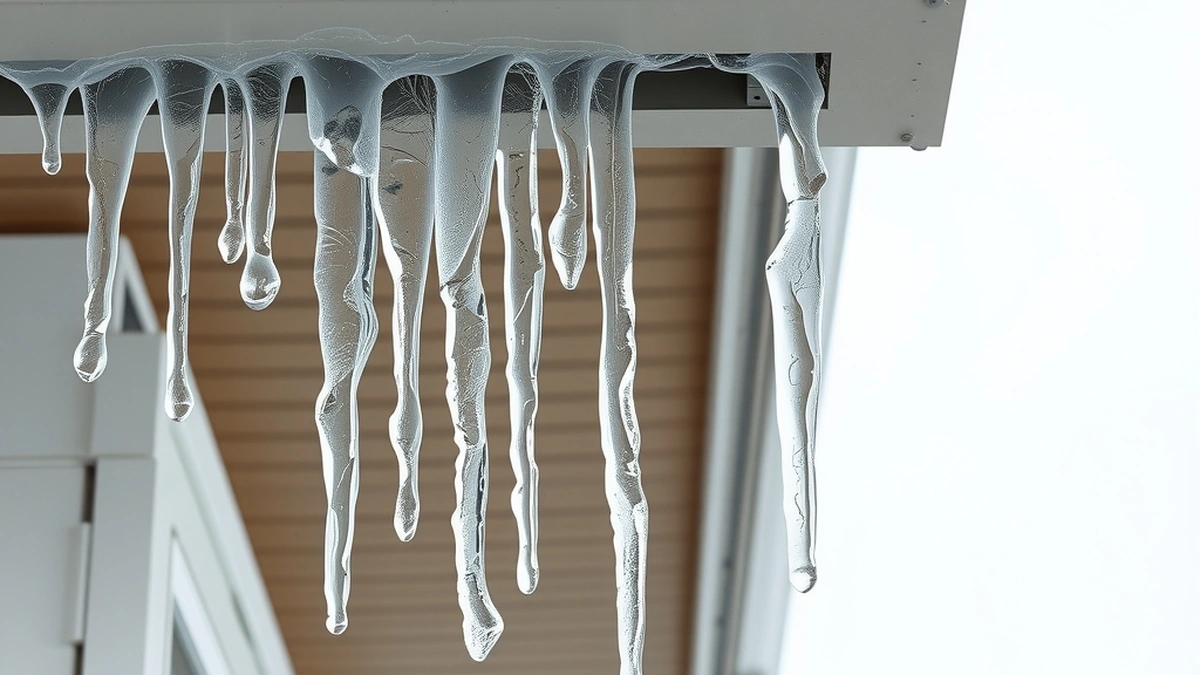
The signs of an ice dam are a solid ice ridge at the eave, icicles hanging from the gutter, frost or meltwater on the roof deck, and water stains on the ceiling near an exterior wall. The ridge is visible from the ground.
- First sign
- Ice ridge at the eave
- Confirmation
- Meltwater on a cold roof
- Interior sign
- Ceiling stain at the wall
- Removal cost
- $300 - $600
Some links on this page are affiliate links.If you buy through them we may earn a commission at no extra cost to you. We do not accept payment for rankings. Read the full disclosure.
An ice dam is visible from the ground before it reaches the ceiling: a solid ridge of ice along the eave, icicles hanging in a continuous band below it, and meltwater running where it should not. The ridge is the sign. Icicles on their own are not, and the difference decides whether you book a $300 to $600 steam removal or ignore a roof that is about to leak.
What separates a dam from ordinary ice
Ice forms at every eave in a cold winter. A dam is a ridge thick enough to block the path of water, and it has three distinguishing features: it spans the eave continuously rather than in patches, it sits above the gutter line, and water is pooling behind it rather than running off the roof.
A single icicle under a downspout is drainage. A curtain of icicles along the whole north eave, with a bulge of ice at the edge, is a dam forming.
The signs, in the order they appear
| Sign | Where to look | What it means | Urgency |
|---|---|---|---|
| Ice ridge at the eave | Roof edge, from the ground | Water path blocked | Act now |
| Continuous icicles | Below the gutter line | Meltwater refreezing | Act now |
| Meltwater on a cold deck | Roof surface above the ridge | Dam is holding water back | Act now |
| Frost in the attic | Underside of sheathing | Warm moist air reaching deck | Investigate |
| Ceiling stain at the wall | Interior, top floor | Water already inside | Repair |
| Gutter pulling from fascia | Along the run | Ice weight on hangers | Structural |
The first three are the dam itself. The last three are its consequences, and they are more expensive to fix.
The ridge and the icicles
Look at the eave after a thaw, not during a snowfall. The ridge shows as a band of grey-white ice that is thicker than the snow line above it, and it usually has a distinct lip where water has been running over and freezing.
Icicles confirm it when they hang in a continuous band rather than from one point. The pattern to worry about is a full-eave curtain with a bulge behind it, because that means water is being held on the roof rather than draining.
Interior signs, and what they mean
A ceiling stain near an exterior wall is the classic ice dam leak. It appears as a brown ring or a damp patch, often a day or two after a thaw, and it grows if the dam stays.
Frost on the underside of the roof sheathing is an earlier signal. It means warm, moist air from the house is reaching a cold surface, which is the same heat loss that feeds the ridge. Seeing it in the attic is a chance to fix the cause before the ceiling shows the symptom.
Check the top floor rooms along the exterior walls, and check the attic deck for frost or damp insulation. Wet insulation loses most of its value even after it dries, so the cost of a leak is not only the drywall.
Structural signs
Ice is heavy. A gutter full of ice is carrying a load it was never designed for, and the hangers are the weakest point. A run that has pulled away from the fascia, or a gutter that has visibly dropped at one end, is a structural warning rather than a drainage one.
At that point the repair order changes: remove the ice first, then check the hangers and the fascia, then deal with the water damage. Pulling a gutter back onto a rotten board without removing the load just repeats the failure.
Six checks after a thaw
- Look along the eave for a continuous ice band rather than patches.
- Note whether icicles form a curtain or hang from one point.
- Watch the roof surface above the ridge for water pooling rather than running off.
- Check the top-floor ceiling within 3 feet of exterior walls for stains.
- Look in the attic for frost on the sheathing and damp insulation.
- Sight along the gutter for a drop or a gap at the fascia.
The whole inspection takes fifteen minutes and needs no ladder. Steps four through six are the ones that decide whether the problem is still a roof problem or has become an interior one.
What the signs cost to act on
A ridge caught at the eave is a $300 to $600 steam removal plus a $150 to $400 gutter clear. A ridge caught after the ceiling stains adds interior repair starting around $1,000, plus the insulation that has to be replaced.
The prevention work is priced separately at $1,500 to $4,000 for air sealing and insulation, and it is the line that stops the sequence from repeating next winter. Read the signs, then spend on the cause.
The short version
The ridge is the sign, the icicles are the confirmation, and the ceiling stain is the bill. Act at the first two. The removal methods are in ice dams: repair options, the budget comparison in ice dams: what a fix costs, and the permanent fix in ice dams: how to prevent it. If the weight has already pulled the run, sagging gutters: repair options covers the next step.
Frequently asked questions
How do I know if I have an ice dam?
Look at the eave after a snow cycle. A continuous ridge of ice along the roof edge, with icicles below it, is an ice dam. A few icicles in a gutter are normal; a solid band is not.
Are icicles always a sign of an ice dam?
No. Small icicles form wherever meltwater drips and refreezes, including from a clear gutter. The sign that matters is a ridge that blocks the eave, because that is what forces water under the shingles.
What does a water stain on the ceiling mean?
That water has already travelled under the shingles, through the deck, and into the insulation and drywall. By that stage the dam has been there for days, and the repair is interior work as well as roof work.
Why is there frost on my roof deck?
Frost on the underside of the deck, or on the sheathing in the attic, means warm moist air is reaching a cold surface. It is the same heat loss that feeds an ice dam, seen from the inside.
Can I see an ice dam from the ground?
Yes. A ridge along the eave and a band of icicles below it are visible from the yard, especially at the end of a thaw. The interior signs need to be checked separately, at the ceiling near exterior walls.
When should I call someone?
When the ridge is solid and the roof has started to leak, or when the ice is heavy enough to pull at the gutter. Removal by steam is $300 to $600, and a gutter pulled off the fascia costs more to repair.
Sources
Some links are affiliate links.If you buy through them we may earn a commission at no extra cost to you. We do not accept payment for rankings. Read the full disclosure.