Sagging gutters: repair options and which one holds
Sagging gutters are re-hung for $200 to $450, re-pitched for $200 to $500, or rebuilt with new hangers and fascia. What causes the dip and which repair lasts.
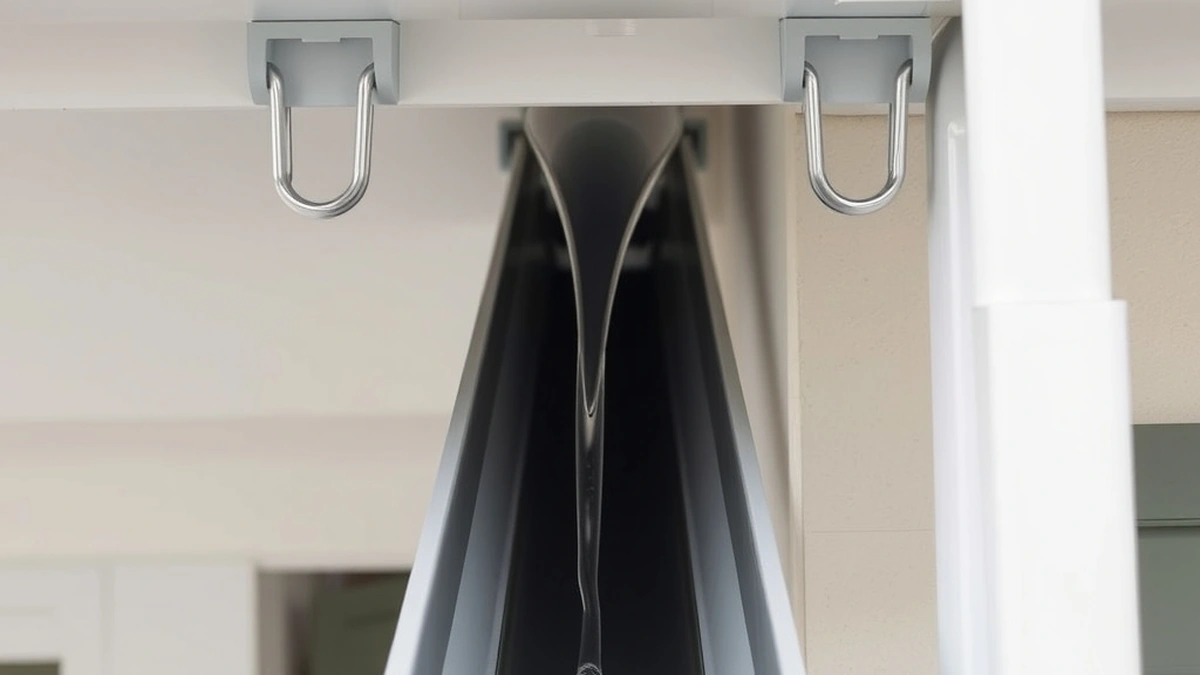
A sagging gutter is repaired by re-hanging the run at $200 to $450, re-pitching it at $200 to $500, or replacing failed hangers and rotted fascia at $6 to $12 per linear foot. The cause decides which repair holds.
- Re-hang a sag
- $200 - $450
- Re-pitch a run
- $200 - $500
- Fascia or hanger work
- $6 - $12 per linear foot
- Long failed section
- $800 - $2,500
Some links on this page are affiliate links.If you buy through them we may earn a commission at no extra cost to you. We do not accept payment for rankings. Read the full disclosure.
A sagging gutter is fixed for $200 to $450 by re-hanging the affected run, or $200 to $500 if the fall has to be re-set at the same time. When the fascia behind the hangers has rotted, the carpentry adds $6 to $12 per linear foot and a long run moves into the $800 to $2,500 band. The repair only holds if it addresses the reason the fasteners let go.
What a sag actually is
A sag is a section of gutter that has dropped below the line of the run, creating a low point where water stands. It is a support failure, not a metal failure, in almost every case: the trough is fine, the hangers or the board they are fixed to are not.
That is why adding a screw to the low point does not fix it. The load that pulled the fastener out is still there, and the next storm puts it back.
Four causes, four repairs
| Cause | Tell-tale | Repair | Cost |
|---|---|---|---|
| Hangers spaced too wide | Even dip between two supports | Add hangers at 24 inches | $200 - $450 |
| Fastener pulled from soft wood | Rust stain at the hole, loose spike | New hidden hangers into sound wood | $200 - $450 |
| Rotted fascia | Screwdriver sinks into the board | Replace fascia, then re-hang | $6 - $12 per ft |
| Wet debris or ice load | Sag appears in winter, recovers in spring | Clear, then re-hang if deformed | $150 - $400 plus repair |
The third row is the one that changes the job. A hanger cannot hold to a board that has no strength left, and no amount of hardware fixes that. The wood is replaced first, then the gutter goes back on with hangers at the correct spacing.
Re-hanging, step by step
- Empty the run and lift out any guard so the trough is accessible.
- Mark the intended fall on the fascia with a chalk line at 1 inch per 10 feet.
- Remove the failed spikes or hangers, keeping the holes visible so they can be sealed.
- Probe the wood at each hole. Soft wood means the fascia is part of the job.
- Fit hidden hangers at 24-inch centres, screwing into the fascia, and clip the inner lip.
- Check the fall with a level before the last hanger is tightened, then flush and test.
Two people are needed for step five on anything longer than about 20 feet, because the gutter has to be held at the chalk line while the hanger is fastened. A single person working alone ends up chasing the line along the run.
Re-pitching versus re-hanging
Re-hanging restores the run to the fall it was installed with. Re-pitching changes the fall, usually because the original was flat or because a new outlet has been added at a different point.
The difference in price is small, $200 to $450 against $200 to $500, so the decision should be made on the measurement. If the run holds water after a re-hang, the fall was wrong and the work has to be done again. Measure first with a 4-foot level, note the gap at the low end, and decide before the crew starts.
When the metal is the problem
Aluminium work-hardens. A section that has sagged and been pulled back repeatedly will crease at the hanger points, and a crease is a permanent low spot that no hanger can lift out. The same happens with a section that froze full of water.
If the crease runs across the base of the trough, replace that length rather than re-hanging it. A splice in a 10-foot section is a normal repair, and it is cheaper than re-hanging a run that will sag again at the same place.
Guards and load
A guard adds weight and catches debris that holds water. On a run with hangers at 36 inches, that extra load is enough to start a new sag within a season. The order is always hangers first, guard second.
This matters for the budget. A micro-mesh system at $1,800 to $4,500 fitted to a run that is already sagging will follow the sag, because the panels are fastened to the gutter. Fixing the run first costs $200 to $500 and protects the larger purchase. The price of the guard itself is in micro-mesh cost.
Repair or replace
Re-hang or re-pitch when the metal is sound, the fascia is solid, and the sag is confined to one or two spans. That covers most jobs at $200 to $500.
Replace the section when the trough is creased, split at a fastener hole, or corroded through. Replace the run when more than a third of the hangers have failed, because the remaining fasteners are on the same board and the same age.
Prices for the replacement route are in gutter replacement cost, and the per-foot arithmetic for repairs by house size is in sagging gutters: what a fix costs. The wider repair menu is in gutter repair cost.
The short version
A sag is a support failure, so the repair is support work: hangers at 24 inches, sound wood behind them, and a fall of 1 inch per 10 feet. That costs $200 to $500 on a typical house. Anything cheaper is a screw in the low point that will pull out again, and anything more expensive usually means the fascia has already gone.
Frequently asked questions
How much does it cost to fix a sagging gutter?
Re-hanging a sag runs $200 to $450 and re-pitching $200 to $500. If the fascia behind the hangers has rotted, add $6 to $12 per linear foot for the carpentry, which pushes a long run to $800 to $2,500.
Can I fix a sagging gutter myself?
On a single storey with sound wood, yes. Empty the run, replace the failed hangers with hidden hangers on 24-inch centres, and re-set the fall at 1 inch per 10 feet. Two people are needed to hold the section while it is fastened.
Why do gutters sag in the middle?
Hanger spacing over 24 inches, fasteners pulled out of soft wood, or the weight of wet debris and ice. A 5-inch aluminium trough full of water is heavy, and the fasteners are the weakest point in the system.
Are hidden hangers better than spikes?
Yes for holding power. Hidden hangers screw into the fascia with a lag or a strap and clip the gutter's inner lip, so the load is spread along the board rather than hung on a single spike driven through the face.
Will gutter guards make sagging worse?
They can. A guard adds weight and catches debris that holds water, and if the hanger spacing is already marginal the extra load accelerates the sag. Fix the hangers before fitting any guard.
When should a sagging gutter be replaced?
When the metal is creased or split at the fasteners, when more than a third of the run has lost its shape, or when the fascia cannot hold a new hanger. Re-hanging a creased section is a temporary repair.
Sources
Some links are affiliate links.If you buy through them we may earn a commission at no extra cost to you. We do not accept payment for rankings. Read the full disclosure.