Brush insert vs foam insert: same price, different fit
Both cost $200 to $800, or $1 to $4 per foot at 200 feet. Brush inserts suit wide troughs and coarse debris; foam suits narrow runs and short-term cover.
Brush and foam inserts cost the same, $200 to $800 installed, or $1 to $4 per linear foot at 200 feet. Brush suits wide troughs and coarse debris; foam suits narrow runs and short-term cover. Both fail on pine needles.
- Brush insert
- $200 - $800
- Foam insert
- $200 - $800
- Per foot at 200 ft
- $1 - $4 both
- Life
- 2 - 4 years
- Best debris
- Coarse leaves
Some links on this page are affiliate links.If you buy through them we may earn a commission at no extra cost to you. We do not accept payment for rankings. Read the full disclosure.
Brush and foam inserts cost the same: $200 to $800 installed, or $1 to $4 per linear foot on a 200-foot house. That is the whole price argument, and it settles nothing. The choice comes down to the shape of the trough, the size of the debris, and how much water the run has to carry.
Two ways to fill a gutter
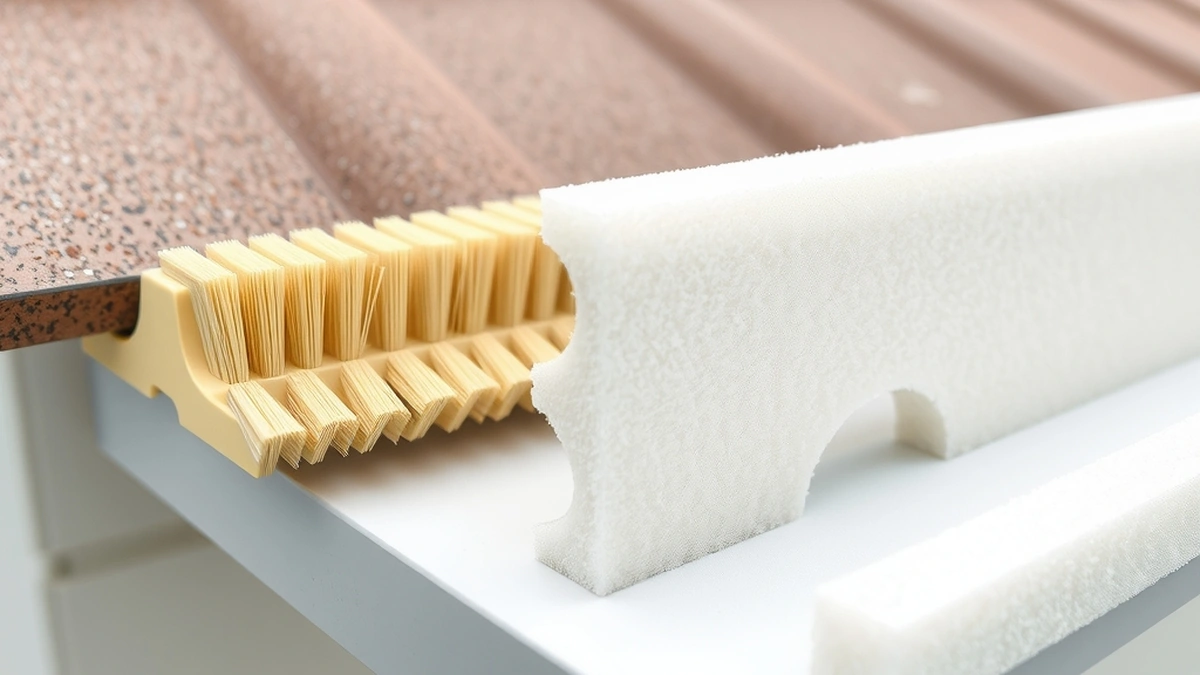
A brush insert is a cylinder of polypropylene bristles on a wire core, pushed into the trough. The bristles stand up like a bottle brush, so water runs between them and leaves rest on top.
A foam insert is a shaped block, usually polyurethane or polyethylene, cut to the gutter profile and pressed in. It fills the volume more completely, and water passes through the open cells.
Both are displacement products. Neither filters. The difference is how much of the channel they occupy and how they behave once they are wet.
Price, life, and capacity
| Item | Brush insert | Foam insert |
|---|---|---|
| Installed | $200 - $800 | $200 - $800 |
| Per foot at 200 ft | $1.00 - $4.00 | $1.00 - $4.00 |
| Expected life | 2 - 4 years | 2 - 4 years |
| Open flow path | Between bristles | Through cells |
| Debris held | On the bristle surface | On the block face |
| Moisture retention | Moderate | High |
| Cleaning | Pull out, shake, rinse | Pull out, rinse, squeeze |
The price is identical because both are commodity plastic with no frame, no fasteners, and no fabrication. The only variable is the length of the run and the profile of the gutter.
Where brush wins
Brush wins in a wide trough. A 5-inch or 6-inch gutter takes a full-diameter brush, the bristles stand against the sides, and water has open channels to run along. A foam block in the same trough has to be cut to a shape that may not match the profile, and gaps at the edges let debris past.
Brush also wins on flow. The bristles do not fill the volume completely, so a heavy rain can pass through even when the surface is partly loaded. Foam depends on its cells, which close as they fill.
And brush is easier to clean. Pull it out, shake it, hose it, push it back. Foam has to be rinsed and squeezed, and the cells never fully clear once grit has packed them.
Where foam wins
Foam wins on a narrow or shallow trough, where a brush of the right diameter will not fit and a cut block will. It also wins on appearance in an open gutter, because it presents a continuous surface rather than a row of bristles.
Foam blocks more debris at the surface, so less material reaches the trough floor. That matters on a run where the debris is coarse and the owner cleans infrequently.
The cost is moisture. Foam holds water, and a wet block against an aluminium gutter is the condition that promotes corrosion at the cut edges and moss in the silt.
What the trough looks like after two seasons
Lift either insert after two seasons and the difference is obvious. The brush comes out as a matted cylinder with leaves woven into the bristles and silt packed at the base, but the gutter floor beneath it is usually still visible and often dry within a day.
The foam comes out heavier than it went in, stained through, and holding water in the cells even after it has been shaken. The gutter floor beneath it is dark, damp, and often coated with a film of silt that has passed through the block. That film is what blocks a downspout strainer.
Neither product leaves the trough clean. The brush leaves it drier, and a dry trough is the one that lasts.
Where both fail
Both fail on pine needles, shingle grit, and pollen. Needles wrap around bristles and cannot be shaken out; grit packs into foam cells; pollen forms a film on either surface. Once that happens, the insert holds water instead of passing it, and the gutter overflows over the front lip.
Both also fail on a long run with a heavy debris load, because the cleaning interval is shorter than the time most owners are willing to spend on a ladder. And both fail in a freeze-thaw climate: water held in bristles or cells expands when it freezes, and the insert is deformed by spring. Foam crumbles at the edges; brush loses its shape and no longer stands against the gutter sides.
Five steps to choose
- Measure the gutter width and depth, and match the insert to the profile.
- Identify the debris. Needles rule out both products.
- Decide how often you will actually clean it.
- Pick brush for flow and easier cleaning, foam for a narrow trough and surface coverage.
- Budget for replacement in two to four years, whichever you choose.
Step five is the honest one. Neither is a permanent installation, and the per-year cost of $50 to $400 is what should be compared with a framed system.
The short version
Same price, different fit. Brush for a wide trough and more flow; foam for a narrow trough and more surface coverage. Both are two-to-four-year consumables that fail on fine debris. The installation methods are in brush insert installation and foam insert installation, and the step up to a permanent guard is priced in gutter guard cost.
Frequently asked questions
Are brush or foam inserts better?
Neither is better in general. Brush works in a wide trough and lets more water through; foam blocks more debris but holds moisture. Both cost the same and both last two to four years.
Why are they the same price?
Because they are both commodity plastic products with no frame and no fasteners. The material cost is low and the price is set by the length of the run, not by the mechanism.
Which one lets more water through?
Brush, in most gutters. The bristles leave open channels along the trough, while foam fills the volume and relies on its cells staying open. Once foam loads with grit, flow drops sharply.
Do either work with pine needles?
No. Needles wrap around brush bristles and pack into foam pores, and neither can be cleaned back to its original flow. A micro-mesh panel is the product for that debris.
Can I install either myself?
Yes. Brush is pushed into the trough and cut to length with pliers or a knife; foam is cut with a knife and pressed in. Neither needs fasteners or roof access beyond a ladder.
How often do they need cleaning?
Two to four times a year in most climates. Both trap material rather than shedding it, so the surface has to be cleared before it packs and blocks flow.
Sources
Some links are affiliate links.If you buy through them we may earn a commission at no extra cost to you. We do not accept payment for rankings. Read the full disclosure.