Sagging gutters: warning signs and how far gone they are
A gutter dip looks small until the fascia rots. Learn the six signs of a sagging run, what each means, and when a $250 re-hang becomes a $1,500 repair.
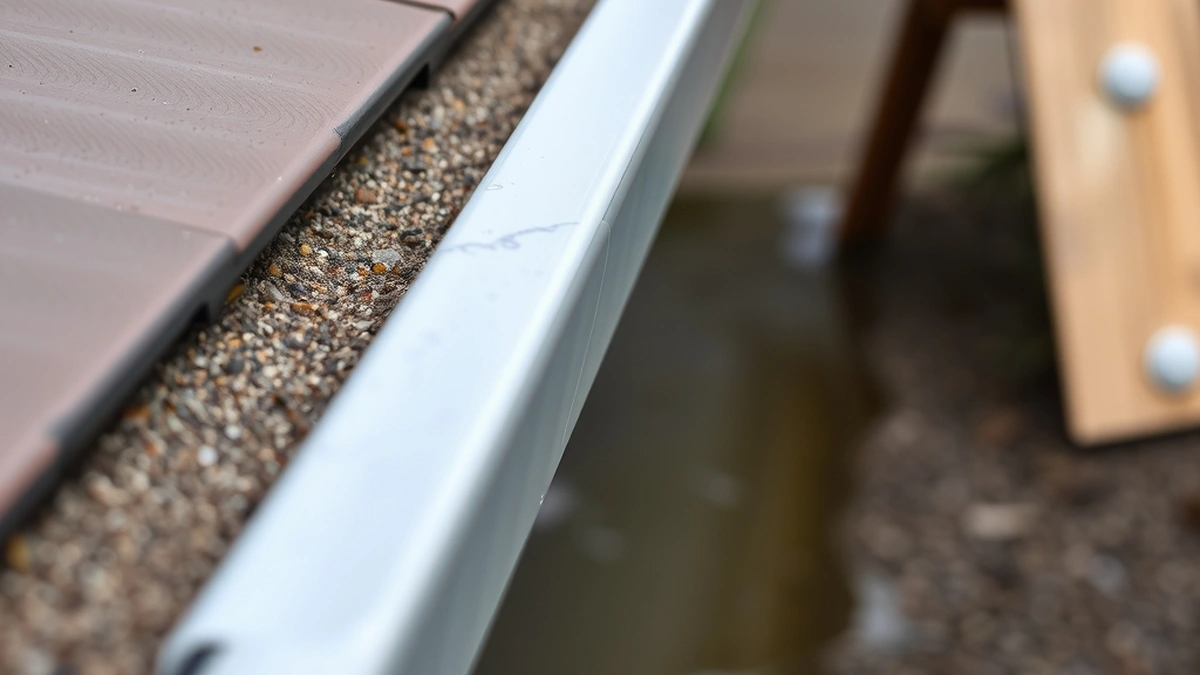
The signs of a sagging gutter are a visible dip in the run, water standing after rain, overflow at the low point, rust or staining at a hanger, a gap between gutter and fascia, and ice forming in one spot. Catch them before the wood softens.
- Earliest sign
- Water standing after rain
- Most visible sign
- A dip in the run line
- Repair if caught early
- $200 - $500
- Repair if fascia rots
- $800 - $2,500
Some links on this page are affiliate links.If you buy through them we may earn a commission at no extra cost to you. We do not accept payment for rankings. Read the full disclosure.
A sagging gutter announces itself in six ways, and the cheapest one to catch is water that is still standing an hour after the rain stops. Catching it then costs $200 to $500 to re-hang. Catching it after the fascia softens costs $800 to $2,500, because the repair stops being about the gutter and becomes carpentry.
The six signs, ranked by how early they appear
| Sign | What you see | What it means | Stage |
|---|---|---|---|
| Standing water | Trough holds water after rain | Fall lost or dip formed | Early |
| Dip in the run line | Gutter below the fascia line mid-run | Hanger has dropped | Early |
| Overflow at one spot | Water leaves the lip in the middle | The dip is now the low point | Mid |
| Streak at a hanger | Rust or dirt at a fastener | Fastener moving in the hole | Mid |
| Gap at the fascia | Daylight between gutter and board | Hanger pulled out | Late |
| Soft wood | Screwdriver sinks into fascia | Board has rotted | Late |
The two early signs are visible from the ground in dry weather. The two late signs require a ladder and a screwdriver, which is why they are usually found by a contractor who was called for something else.
Standing water and the dip
Water should leave a gutter within minutes of the rain stopping. If a puddle is still there the next morning, the run has lost its fall, and the cause is either the original pitch or a support that has dropped.
Sight along the front lip from one end. A straight run reads as a continuous line against the fascia; a sag reads as a shallow curve with the lowest point somewhere in the middle. On a long run, sight from both ends, because a dip near the far end is easy to miss from the near one.
Overflow that starts in the middle
Overflow at the end of a run usually means a blocked outlet. Overflow in the middle means the middle is the low point, and water is leaving the lip before it ever reaches the downspout.
That is a useful diagnostic distinction. If the stain on the fascia is under the centre of the run and the outlet at the end is clear, the problem is support, not debris. Clearing the gutter will not fix it, and neither will a guard.
Fasteners, streaks, and gaps
A hanger that has begun to fail leaves a witness mark. The fastener moves in its hole as the load shifts, the coating breaks, and water gets in. What you see from below is a rust streak or a dark line running down the fascia from the hanger position.
Later, the hanger pulls out far enough that a gap opens between the gutter and the board. At that point the gutter is hanging on the remaining fasteners, and the load on them has doubled. This is the stage where a ladder check is urgent rather than optional.
Probe the wood with a screwdriver at the lowest hanger. If the tip sinks easily, the board is holding water. No new hanger will hold in that wood, so the fascia is part of the repair.
Ice and the winter read
In a cold climate, a sagging run shows up as ice in one place. Water collects at the dip, freezes, and builds a lump that does not clear with the rest of the eave. The lump is a map of the low point.
That matters because ice adds load to an already failing support. A run that sags 1 inch in autumn can sag 3 inches by February, and the fasteners that were marginal in October come out entirely.
Six checks, cheapest first
- Look along the gutter line from both ends of the house in dry weather.
- Check for standing water an hour after rain, and note where it sits.
- Look at the fascia under the middle of the run for a stain or a rust streak.
- Note whether overflow happens at the end or in the middle.
- From a ladder, press the gutter up at the dip. Movement means the hanger has failed.
- Probe the wood at the lowest hanger with a screwdriver.
Steps one to four need no equipment. Step five needs a ladder and a second person to watch, and step six is the one that decides whether the repair is $250 or $1,500.
What the stage means for the bill
At the early stage, a re-hang at $200 to $450 or a re-pitch at $200 to $500 restores the run, and the fascia stays. At the mid stage the same repair works, but the fasteners need sealing and the hanger positions may have to move.
At the late stage the fascia is replaced at $6 to $12 per linear foot, then the gutter goes back on. On a 60-foot affected run that is $360 to $720 of carpentry plus the re-hang, which is how a $250 job becomes $1,500.
The short version
Read the water, not the metal. Standing water and a dip are the early warning; a stain at a hanger and a gap at the fascia are the late one. The repair options at each stage are in sagging gutters: repair options, the cost breakdown is in sagging gutters: what a fix costs, and the routine that prevents the whole sequence is in sagging gutters: how to prevent it.
Frequently asked questions
How can I tell if my gutters are sagging?
Sight along the run from one end. A sag shows as a dip below the straight line of the fascia, and it usually holds water for hours after the rain stops. Both are visible from the ground.
What does standing water in a gutter mean?
Either the fall is wrong or the run has dropped between hangers. Water should reach the outlet within minutes; if it is still there the next morning, the support or the pitch has failed.
Why does water overflow at one spot?
Because that is the low point of the run. Water collects there and leaves over the front lip, which is why the stain and the erosion line up under the middle of the gutter rather than at the ends.
What does a rust streak at a hanger mean?
The fastener has been moving in the hole, breaking the coating and letting water in. It is the earliest visible sign of hanger failure and the cheapest point to intervene.
Can a sagging gutter damage the roof?
It can damage the fascia and the soffit, and water that runs behind the gutter can reach the roof structure. The gutter itself rarely damages the roof covering unless it pulls away and dumps water at the wall.
How long can I leave a sagging gutter?
One season at most. A $200 to $500 re-hang becomes an $800 to $2,500 fascia repair once the board softens, and the water reaching the wall adds interior repairs on top.
Sources
Some links are affiliate links.If you buy through them we may earn a commission at no extra cost to you. We do not accept payment for rankings. Read the full disclosure.