Micro mesh gutter guard
How stainless micro-mesh guards work, what aperture actually blocks, install costs from $1,800 to $4,500, and where the mesh still clogs.
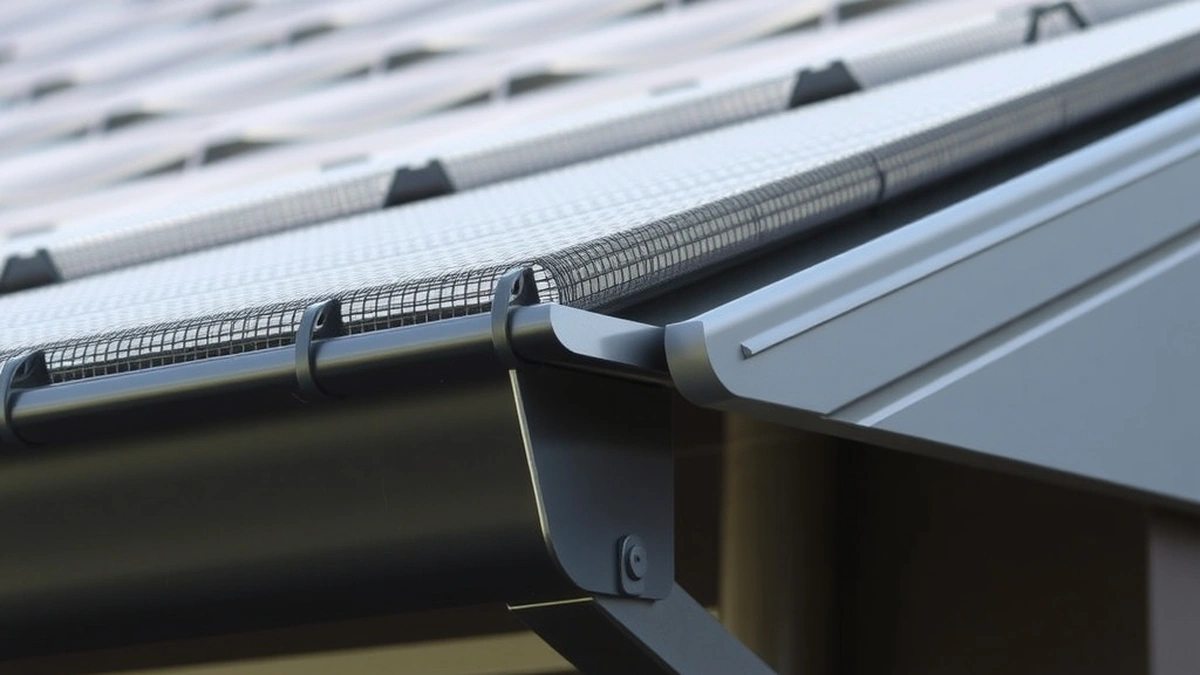
A micro-mesh gutter guard is a fine stainless or coated mesh panel fixed over the gutter, with openings narrow enough to hold back pine needles and roof grit while water passes through. Installed cost runs $1,800 to $4,500.
- Installed cost
- $1,800–$4,500
- Typical aperture
- Under 1 mm
- Screen alternative
- $300–$900
- Cleaning baseline
- $150–$400
Some links on this page are affiliate links.If you buy through them we may earn a commission at no extra cost to you. We do not accept payment for rankings. Read the full disclosure.
A micro-mesh gutter guard is a panel of fine stainless steel or coated mesh fixed over the gutter opening, with apertures narrow enough to hold back pine needles and shingle grit while rainwater drains through. Installed systems cost $1,800 to $4,500 on a typical home, roughly four times a DIY screen at $300 to $900. The extra money buys a smaller hole size, and whether that is worth it depends entirely on what falls on your roof.
What Micro-Mesh Actually Is
The product is a mesh cloth, usually stainless steel, bonded to an aluminum or steel frame that clips or screws to the gutter. Aperture size is the defining spec: standard gutter screens have openings measured in fractions of an inch, while micro-mesh apertures are generally under a millimeter, and the finest products are finer still.
That single number drives everything else. A smaller aperture blocks more debris, drains slightly slower, and clogs faster with the particles it does let through. Manufacturers balance the three, and different products sit at different points on that trade-off.
How It Passes Water and Holds Debris
Water behaves differently at small scales. On a coarse screen, water falls through the openings in sheets and carries small debris with it. On micro-mesh, surface tension spreads the water across the mesh, and it drains through the pores while solids stay on top.
Debris that lands on the panel is meant to dry and blow off, or be brushed away during routine clearing. The design assumes the roof sheds debris in a form that does not mat: dry leaves and needles slide, wet leaves stick. In a heavy fall storm, wet debris can blanket the panel and sheet water over the front edge, which is the failure mode homeowners notice first.
The other direction matters too. Anything small enough to pass the aperture — pollen, dust, shingle granules, grit — ends up in the trough as sediment. It does not block the guard, but it does accumulate, and after several years it can be deep enough to matter.
What It Stops, and What It Doesn’t
Micro-mesh is effective against the debris that causes most clogs:
- Deciduous leaves, which sit on top rather than washing in
- Pine needles, the debris that defeats coarse screens
- Twigs, seed pods, and small branches
- Shingle granules and roof grit
- Birds and large insects looking for a nesting site
It is not effective against fine sediment passing through the aperture, against moss and algae growing on a damp panel, or against ice that bonds to the mesh in a cold snap. It also cannot fix a gutter that pitches the wrong way or a downspout that is too small; overflow from either looks exactly like overflow from a clogged guard.
Micro-Mesh vs Screens, Inserts, and Reverse Curve
The comparison is mostly about aperture and price, and each type wins in a different setting.
| Guard type | Installed cost | Blocks pine needles | Best setting |
|---|---|---|---|
| Micro-mesh | $1,800–$4,500 | Yes | Heavy fine debris, tree cover |
| Reverse curve | $2,000–$5,000 | Partly | Heavy leaf load, straight runs |
| DIY screen | $300–$900 | No | Light debris, budget jobs |
| Brush or foam insert | $200–$800 | No | Small runs, temporary fix |
| Dealer system | $3,000–$8,000 | Yes | Buyers who want a warranty |
Micro-mesh versus reverse curve is the interesting pair. Reverse curve uses surface tension to pull water around a curved nose into the gutter, and it handles big leaf volume well. Micro-mesh relies on pore size, so it handles small debris that reverse curve lets through, but it needs more frequent surface clearing. On a roof under pines, micro-mesh wins. On a long straight run under maples, a reverse curve often performs just as well for similar money.
Installation: What the Job Involves
A proper install starts with the gutter cleaned and empty, because debris trapped under a guard is debris you will not see again until it causes a problem. The crew then checks pitch and hangers, fixes anything loose, and fits the panels.
Panels are cut to length on site, with fabricated corners and end caps where the run turns. Fastening varies: some systems screw through the front lip of the gutter, some use brackets into the fascia, and some clip over the outer edge. On a two-story house, the crew works from ladders or stands, which is why the labor share rises with height.
Expect one day for a one-story house with 150 to 250 linear feet, and two for a complex roofline or a job that includes removing an old system. OSHA’s fall-protection requirements govern how the crew works above six feet, and a contractor who cannot describe their fall protection is not a contractor to hire.
Keeping the Aperture Open
Micro-mesh reduces cleaning frequency but does not remove it. The maintenance is different from cleaning a bare gutter, and it is faster.
- Clear the roof surface above each run in late fall so debris does not wash down onto the panel in the first storm.
- Brush or rinse the panel from the high end toward the downspout in spring, pushing debris off the edge rather than into the gutter.
- Check the corners and valleys, where debris collects first and where a dam forms quickly.
- Lift one panel a year and look at the trough floor for sediment that passed through the mesh.
- Test flow at the high end with a hose and confirm the downspout outlet runs clear.
If you are not comfortable on a ladder, this is a service call, not a DIY task. Professional cleaning runs $150 to $400, and surface clearing on a guarded gutter usually sits at the lower end because there is less volume to remove.
Where Micro-Mesh Fits in a Drainage Plan
A guard is a debris cover, not a drainage system. It works when the gutter is correctly sized, pitched toward the outlets, and connected to downspouts that discharge away from the foundation. Add micro-mesh to a gutter with those problems and you have an expensive cover on a system that still overflows.
On a house with pines, oaks, or a mix of fine and coarse debris, micro-mesh is the most defensible choice in the category. On a house with light debris and cheap cleaning, the $1,800 to $4,500 installed cost buys convenience rather than savings, and our is gutter guard worth it breakdown runs that comparison.
Bottom Line
Micro-mesh blocks pine needles, grit, and small debris that coarser screens let through, at $1,800 to $4,500 installed against $300 to $900 for DIY screens and $3,000 to $8,000 for dealer systems. It still needs surface clearing once or twice a year, and fine sediment still reaches the trough. Buy it where the debris is fine and plentiful; skip it where the roof is clean and cleaning is cheap. For the wider product comparison, see types of gutter guard and mesh gutter guards.
Frequently asked questions
What is a micro mesh gutter guard?
It is a panel of very fine stainless steel or coated mesh, mounted over the gutter opening, with apertures narrow enough to block pine needles and shingle grit while letting rainwater through.
How much does a micro mesh gutter guard cost?
Professionally installed systems typically run $1,800 to $4,500 for a standard home, compared with $300 to $900 for DIY screens and $3,000 to $8,000 for dealer-branded systems.
Does micro mesh stop pine needles?
Yes, that is its main advantage over a standard screen. The finer aperture holds needles on the surface instead of letting them wash into the trough, though they still need clearing.
Can micro mesh clog?
Yes. Pollen, dust, and shingle granules can seal the aperture over time, and debris sitting on top blocks water just as effectively as debris inside the gutter.
Can I install micro mesh myself?
Some panel products are sold to homeowners, but fitting frames to the gutter profile and fastening without crushing the lip is difficult, and most systems are contractor-installed.
How long does micro mesh last?
Stainless micro-mesh systems commonly last 15 to 25 years, with the frame and fasteners usually failing before the mesh itself.
Sources
Some links are affiliate links.If you buy through them we may earn a commission at no extra cost to you. We do not accept payment for rankings. Read the full disclosure.