Gutter guard installation cost
What the install itself costs, how labor splits from materials, and the add-ons that quietly push a gutter guard quote past the advertised range.
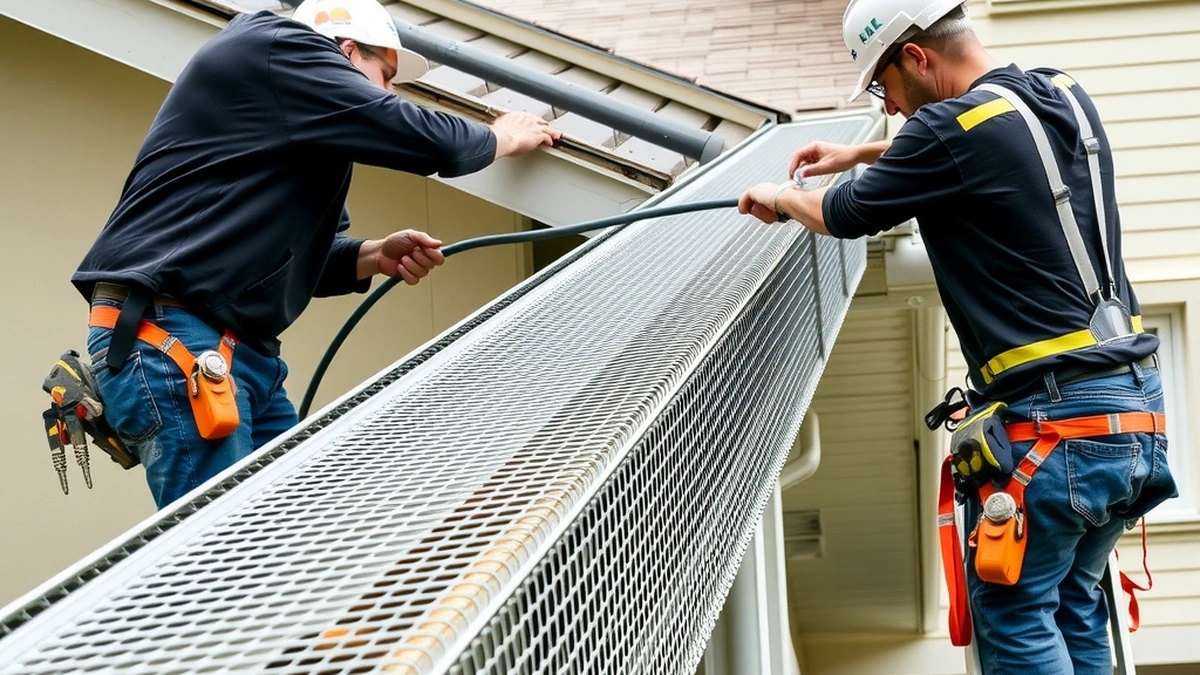
Gutter guard installation costs $1,800 to $4,500 for micro-mesh, $2,000 to $5,000 for reverse curve, and $3,000 to $8,000 for dealer systems. About half of that is labor.
- Micro-mesh, installed
- $1,800–$4,500
- Reverse curve, installed
- $2,000–$5,000
- Dealer system
- $3,000–$8,000
- DIY screens, materials
- $300–$900
Some links on this page are affiliate links.If you buy through them we may earn a commission at no extra cost to you. We do not accept payment for rankings. Read the full disclosure.
Gutter guard installation costs $1,800 to $4,500 for micro-mesh, $2,000 to $5,000 for reverse curve, and $3,000 to $8,000 for dealer-brand systems. Roughly half of a typical quote is labor, and that share climbs with roof height, roofline complexity, and anything that has to come off before the new guard goes on. The product is the easy part to price; the install is where quotes diverge.
What Installation Costs by Product
The figures below are installed prices for a standard one-story home with 150 to 250 linear feet of gutter. They include material, fasteners, and labor, but not gutter repair, old-guard removal, or pre-install cleaning.
| Product | Installed cost (estimate) | DIY materials only |
|---|---|---|
| Brush or foam insert | $200–$800 | Same, homeowner-installed |
| Screen guard | $300–$900 | Same, homeowner-installed |
| Micro-mesh | $1,800–$4,500 | Not commonly sold as a kit |
| Reverse curve | $2,000–$5,000 | Rarely available to homeowners |
| Dealer-brand system | $3,000–$8,000 | Dealer-installed only |
The DIY row is the tell. Inserts and screens are sold as consumer products because the installation is trivial: cut to length, push into the gutter, clip the ends. Micro-mesh and reverse curve are contractor products because fitting them requires cutting frames to the gutter profile, aligning pitch, and fastening through the front lip or fascia without crushing the gutter.
Labor and Materials Split
On a micro-mesh job, material is the smaller half. A $3,000 install on 200 feet typically breaks down to roughly $1,200 to $1,500 in material and $1,500 to $1,800 in labor, though contractors rarely itemize it that way on the quote.
That split matters when comparing bids. Two quotes that differ by $900 on the same product are usually differing on labor hours and crew size, not material grade. Ask how many workers, how many days, and what the per-hour rate is, and the gap becomes legible.
It also explains why small jobs cost more per foot. A 60-foot run still needs a crew, a vehicle, setup, and teardown. The fixed cost is spread over less material, so the per-foot price rises.
Per Linear Foot, With the Arithmetic
Convert every quote to a per-foot figure before comparing anything. Divide the total by the linear footage of gutter on the house.
On a 200-foot run, $1,800 is $9.00 per foot and $4,500 is $22.50 per foot. Reverse curve at $2,000 to $5,000 works out to $10 to $25 per foot on the same run. A dealer system at $3,000 to $8,000 is $15 to $40 per foot.
| Linear feet | Micro-mesh $1,800 | Micro-mesh $4,500 | Dealer $8,000 |
|---|---|---|---|
| 150 ft | $12.00/ft | $30.00/ft | $53.33/ft |
| 200 ft | $9.00/ft | $22.50/ft | $40.00/ft |
| 250 ft | $7.20/ft | $18.00/ft | $32.00/ft |
Several rows in that table are beyond what most contractors charge per foot; they exist to show how the same total becomes a different rate on a smaller house. Always compute both numbers: total, and total divided by footage.
Add-Ons That Change the Quote
Installation quotes grow through line items. These are the common ones:
- Old guard removal. Tearing off an existing system and disposing of it adds labor, often $200 to $500 on a standard house.
- Pre-install cleaning. Guards go on an empty gutter. If cleaning is excluded, budget $150 to $400 separately.
- Gutter repair. Sagging runs, pulled hangers, and open seams have to be fixed first. Ask for a per-foot price for fascia repair before work begins.
- Downspout screens and extensions. Small parts, small prices, easy to forget.
- Custom corners and end caps. Complex rooflines need fabricated pieces, and fabrication is labor.
- Permits. Rarely required for guard work on a single-family house, but some jurisdictions require them for exterior alterations.
A quote that excludes three of these is not cheaper; it is incomplete. Compare the finished scope, not the headline number.
Two-Story and Complex Roofs
Height is the largest single multiplier. Working at 20 feet means taller ladders, more setup, and slower movement along the run. Many contractors price a second story at a meaningful premium over a first-story job, and a third story higher still, often requiring a lift or roof access rather than ladders.
Roofline complexity is the second. Valleys, dormers, and short runs between roof planes mean more cutting, more waste, more fastening points, and more places for water to find a gap. A simple gable roof is the cheapest shape to guard; a hip roof with dormers is the most expensive per foot.
Both factors are visible before anyone quotes. If your house has either, expect the upper half of every range on this page, and ask each contractor to explain what they saw that moved the number.
How to Read an Installation Quote
- Confirm the linear footage the quote is based on, and measure a couple of runs yourself to check it.
- Identify the product by name, material, and mesh aperture, not by a marketing label.
- Check whether removal, cleaning, and any gutter repair are included or excluded.
- Ask for the fastening method in writing: screws into fascia, hidden hangers, or clips on the gutter lip.
- Confirm the crew size and expected duration, since both drive labor cost.
- Get the warranty terms in writing, separating material coverage from workmanship coverage.
Two quotes that pass all six checks can be compared honestly. Anything less is comparing a scope to a number. Our guide to finding a gutter guard contractor near you covers the credential checks that go alongside the quote.
What Installation Should Include
A competent install starts with the gutter clean and empty, pitched correctly, and free of loose hangers. The crew then fits panels to the run, cuts at corners and end caps, fastens at a spacing that matches the product’s spec, and tests water flow at the high end before leaving.
Ask for photographs of the finished runs and of any repair work. On a two-story house you cannot inspect the result yourself, and a photo record is the only practical way to confirm the panels are seated and the fasteners are in the fascia rather than in the gutter lip.
Bottom Line
Installed gutter guards cost $1,800 to $4,500 for micro-mesh, $2,000 to $5,000 for reverse curve, and $3,000 to $8,000 for dealer systems, with labor at roughly half the total and rising on tall or complex roofs. Divide every quote by your linear footage, confirm what is excluded, and price the add-ons before signing. For product-level detail, see gutter guard cost; for what happens on the day, read gutter guard installation.
Frequently asked questions
How much does gutter guard installation cost?
Most homeowners pay $1,800 to $4,500 for installed micro-mesh, $2,000 to $5,000 for reverse curve, and $3,000 to $8,000 for a dealer-brand system.
How much of the price is labor?
Labor is typically about half the total on a one-story house and more on taller homes, since the material itself is a modest part of a micro-mesh job.
How much does installation cost per linear foot?
On a 200-foot run, installed micro-mesh works out to $9 to $22.50 per linear foot, and dealer systems to $15 to $40 per foot.
Is installation cheaper in winter?
Sometimes. Crews are less booked outside the fall leaf season, so scheduling in late winter or early spring can produce better availability and occasionally a better price.
Does gutter guard installation include cleaning?
Not always. Guards must go onto a clean, empty gutter, so confirm whether pre-install cleaning is included or billed separately at $150 to $400.
How long does the install take?
A one-story house with 150 to 250 linear feet usually takes one day for two or three workers. Complex rooflines or old guard removal can add a second day.
Sources
Some links are affiliate links.If you buy through them we may earn a commission at no extra cost to you. We do not accept payment for rankings. Read the full disclosure.