Brush insert cost
What brush gutter inserts cost per linear foot and per job, how material and labor split, DIY savings, and how the total compares to other guard types.
Brush gutter inserts cost $200 to $800 installed on a typical home, which works out to $1.00 to $4.00 per linear foot on a 200-foot run. Material alone is a fraction of that, and the low price is the main reason buyers consider them.
- Installed, 200 ft
- $200–$800
- Cost per linear foot
- $1.00–$4.00
- Micro-mesh, same run
- $1,800–$4,500
- Cleaning baseline
- $150–$400 per visit
Some links on this page are affiliate links.If you buy through them we may earn a commission at no extra cost to you. We do not accept payment for rankings. Read the full disclosure.
Brush gutter inserts cost $200 to $800 installed on a typical home, or $1.00 to $4.00 per linear foot on a 200-foot run. That is the cheapest of the common guard types by a wide margin, and the price is the whole reason the product exists. What the number does not tell you is how much of the job it actually solves.
What the Price Buys
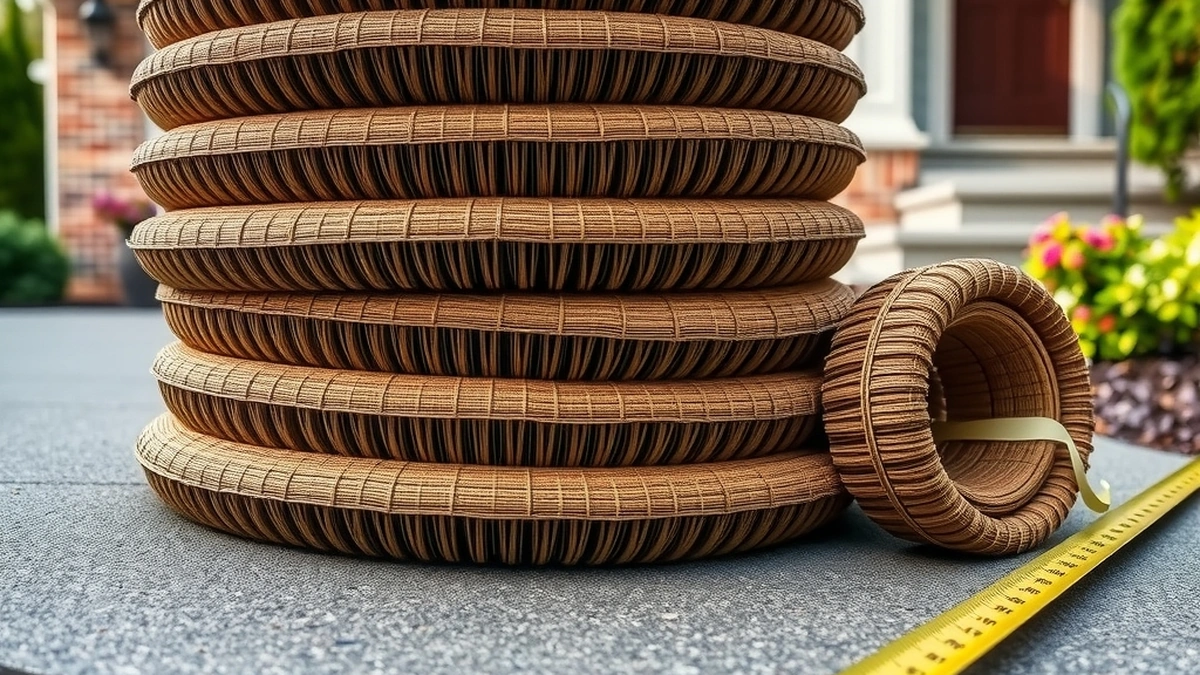
A brush gutter insert is a cylinder of stiff polypropylene bristles, usually 3 to 4 inches in diameter, laid end to end inside the gutter trough. Water flows between the bristles; leaves and twigs sit on top and dry out. There is no frame, no fastener and no cutting to a gutter profile, which is why the installed price stays low.
The comparison set matters more than the absolute number. Micro-mesh installed on the same house runs $1,800 to $4,500, reverse-curve runs $2,000 to $5,000, a DIY screen at $300 to $900, and a dealer-sold system at $3,000 to $8,000. A brush insert at $200 to $800 is roughly a tenth of a micro-mesh job, and about the same as one to five professional cleanings at $150 to $400 a visit.
Cost per Linear Foot
Take a 200-foot run, a common figure for a single-story house with a straightforward roofline.
- Low end: $200 ÷ 200 ft = $1.00 per linear foot.
- High end: $800 ÷ 200 ft = $4.00 per linear foot.
- On a shorter 120-foot run the same $200 to $800 becomes $1.67 to $6.67 per foot, because the minimum charge and the trip are spread over less work.
- On a 300-foot run it becomes $0.67 to $2.67 per foot.
That spread is the single most useful thing to understand about brush insert pricing: the per-foot number is not stable, and a quote that looks high per foot may simply be a small job.
Material Versus Labor
The material is the cheap part. Inserts are sold in 3-foot and 4-foot lengths, and a 200-foot run needs 50 to 67 pieces laid end to end. A crew buys in bulk; a homeowner buys retail by the box, which is why the DIY material bill sits near the bottom of the installed range rather than in the middle.
Labor is measuring, buying, carrying, and pushing lengths into the trough, plus clearing whatever is already in the gutter before the insert goes down. That last step is not optional and is often the largest single line, because a gutter full of wet leaves has to be emptied by hand before anything can be laid in it.
| Line item | Share of an installed job | What moves it |
|---|---|---|
| Insert material | Roughly a third on a short run | Bristle density, diameter, brand |
| Pre-clear of the trough | A quarter to a third | How long since the last cleaning |
| Installation labor | The balance | Run length, roof height, corners |
| Disposal | Small | Whether the old debris leaves site |
| Travel and minimum charge | Fixed | Distance, one-story versus two-story |
Shares are typical planning estimates, not quoted rates.
What Changes the Quote
Height is the biggest variable after run length. A single-story run can be worked from a stepladder; a two-story run needs extension ladders or stands, and OSHA fall-protection rules apply above six feet, which slows the crew down.
Corners cost more than straight feet because a brush length has to be cut and butted tightly at each turn, and a gap at a corner lets debris straight through. Downspout outlets are the other detail: the insert has to stop short of or be notched around the outlet so it does not dam water at the lowest point of the run.
Gutter condition sets a floor on the price. Sagging hangers, separated joints, or a trough holding standing water all have to be dealt with first, and a crew that skips that step is selling you an insert that will sit in a puddle.
DIY Versus Installed
Doing it yourself removes the labor line and most of the travel charge. It also removes the fall protection, the debris disposal and the inspection that a crew would do while the gutter is open. On a single-story ranch with clean gutters and light debris, that trade is reasonable. On a two-story house with a valley dumping onto the run, it is not.
If you do install yourself, buy the length by measuring each run separately rather than multiplying the total, because corner cuts eat into the count. Wear gloves; the cut ends of polypropylene bristles are sharp.
Five Seasons of Arithmetic
The honest comparison is not insert versus no insert, it is insert versus cleaning. Two cleanings a year at $150 to $400 each is $300 to $800 annually.
- 5 years of cleaning: $300 × 5 = $1,500 at the low end; $800 × 5 = $4,000 at the high end.
- 5 years of insert plus reduced cleaning: $200 to $800 installed, plus one lighter cleaning a year at the low end of $150, which is $750 to $1,550 total.
- The saving is real but modest, and it depends on the insert actually reducing the debris that reaches the trough.
Where the insert does not pay is heavy needle or grit load. Bristles do not filter, so fines pass straight through and settle on the gutter floor, and the insert now sits on top of the sediment where it is harder to see.
Before You Accept a Quote
- Ask for the linear footage in writing, and measure a run yourself to check it.
- Confirm whether the price includes clearing the existing gutter and hauling the debris away.
- Ask what happens at corners and at each downspout outlet, and get the answer in the quote.
- Confirm the bristle diameter suits the trough depth; an insert that sits proud of the gutter lip catches debris at the edge.
- Compare the total against one year of cleaning at $150 to $400 a visit, then decide whether the convenience is worth the difference.
For the installation side, see brush insert installation; for where the product underperforms, see brush insert problems. The broader per-foot picture is in gutter guard cost per square foot and gutter guard cost.
Bottom Line
Brush inserts are the cheapest guard at $200 to $800 installed, or $1.00 to $4.00 per linear foot on a 200-foot run, and they are priced accordingly: no frame, no fasteners, no filtration. They buy time between cleanings on short runs with light, coarse debris. They do not buy a solution on a roof shedding needles or shingle grit, where the same money is better spent on a screen at $300 to $900 or saved toward a mesh system at $1,800 to $4,500.
Frequently asked questions
How much does a brush gutter insert cost?
Professionally installed brush inserts run $200 to $800 on a typical home, against $1,800 to $4,500 for micro-mesh and $2,000 to $5,000 for reverse-curve covers.
What is the price per linear foot?
Divide the installed range by the run length. On 200 feet, $200 to $800 works out to $1.00 to $4.00 per linear foot, and the price per foot falls as the run gets longer because the trip charge is spread over more work.
Is it cheaper to install brush inserts myself?
Yes. The inserts are sold retail in short lengths and need no fasteners, so a homeowner pays material only. Labor is a large share of the installed price and is what you avoid by doing it yourself.
Do brush inserts cost less than cleaning?
Usually not over time. Two cleanings a year at $150 to $400 each is $300 to $800 annually, so a $200 to $800 insert pays for itself in one or two seasons but does not remove the need to clean.
Why do quotes for the same house differ so much?
Run length, roof height, the number of corners and the condition of the gutter all change the number. A two-story house with a complex roofline needs ladders, stands and more hours than a single-story straight run.
Are brush inserts worth the money?
They are worth it as a cheap barrier on short runs with light debris, or as a stopgap before a larger purchase. They are a poor value where needles, grit or heavy leaf loads are the problem, because they do not stop the debris that causes the worst clogs.
Sources
Some links are affiliate links.If you buy through them we may earn a commission at no extra cost to you. We do not accept payment for rankings. Read the full disclosure.