Water overflowing: repair options and what fixes it
Why gutters overflow and the four repairs that stop it: clearing at $150 to $400, re-pitching at $200 to $500, re-hanging, and resizing the outlet.
Gutter overflow is fixed by clearing the blockage at $150 to $400, re-pitching the run at $200 to $500, re-hanging a sag at $200 to $450, or adding downspout capacity at $400 to $1,000 for four runs. Most overflows are a water-path fault, not a gutter fault.
- Clear a blockage
- $150 - $400
- Re-pitch a run
- $200 - $500
- Re-hang a sag
- $200 - $450
- Four new downspouts
- $400 - $1,000
Some links on this page are affiliate links.If you buy through them we may earn a commission at no extra cost to you. We do not accept payment for rankings. Read the full disclosure.
Gutter overflow is usually repaired for $150 to $600, and the money goes to one of four fixes: clearing a blocked outlet, re-pitching a run that drains backwards, re-hanging a sag, or adding downspout capacity. The product on top of the gutter is rarely the cause. Water leaves the front lip because it cannot leave the trough fast enough, and that is a plumbing problem in a horizontal pipe.
What overflow actually is
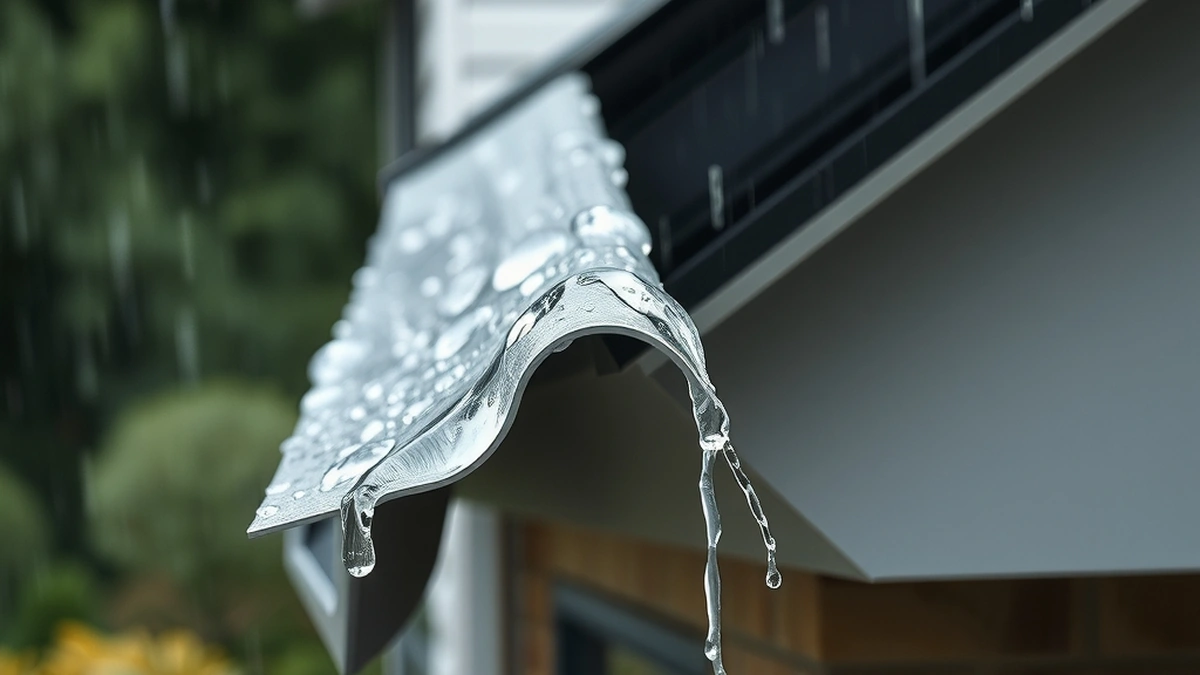
Overflow is water leaving the gutter anywhere other than the downspout: over the front lip, behind the back edge, at a joint, or off the end of the run. It is a capacity or alignment failure, not a gutter failure, which is why replacing the gutter rarely fixes it.
The trough is a channel with a fall, an outlet, and a fixed cross-section. Water exits when any one of those three stops working. Diagnosis is a matter of finding which one.
The four causes, priced
| Cause | Tell-tale | Repair | Cost |
|---|---|---|---|
| Blocked outlet or downspout | Water at the low end, debris at the strainer | Clear and flush | $150 - $400 |
| Wrong pitch | Standing water after rain | Re-set hangers to 1 in per 10 ft | $200 - $500 |
| Sag between hangers | Dip mid-run, overflow at the dip | New hangers or spikes | $200 - $450 |
| Undersized downspout | Overflow in every heavy storm, not just debris | Add or enlarge outlets | $400 - $1,000 |
| Failed joint or end cap | Streaks at one seam | Reseal or replace section | $150 - $600 |
Those are estimates for a single-storey house and assume the gutter itself is sound. A run that has rusted through, or a fascia board that has rotted behind the hangers, moves the job into the $800 to $2,500 band because the repair is no longer about water.
Clearing the blockage first
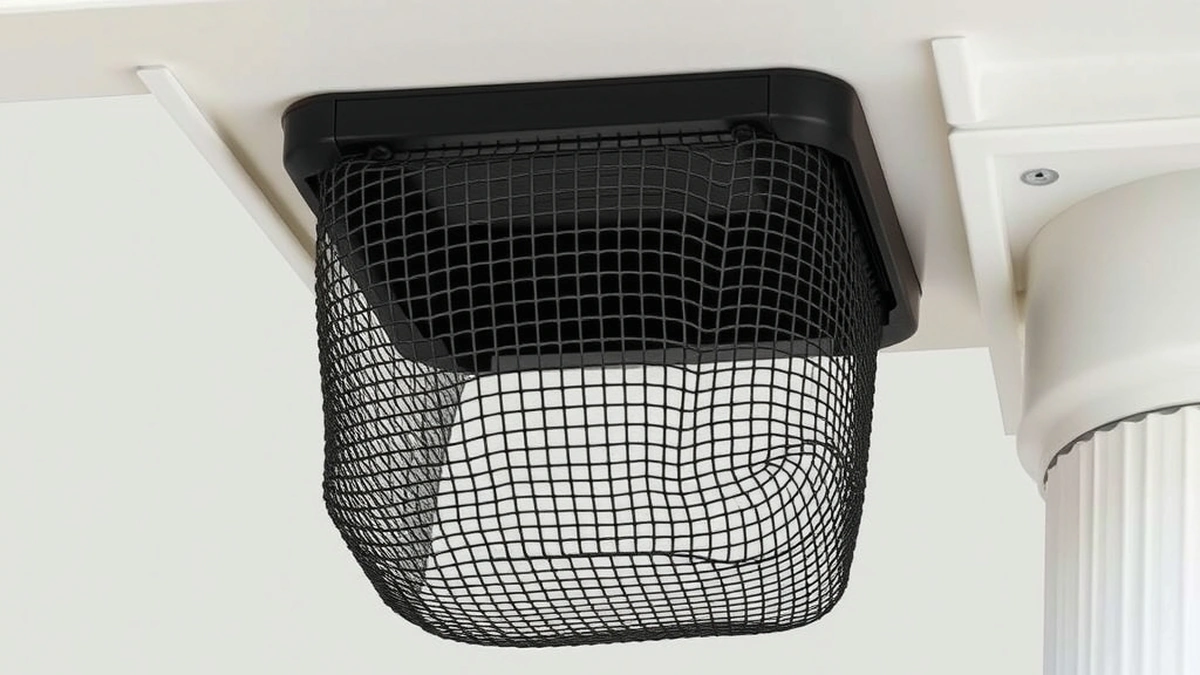
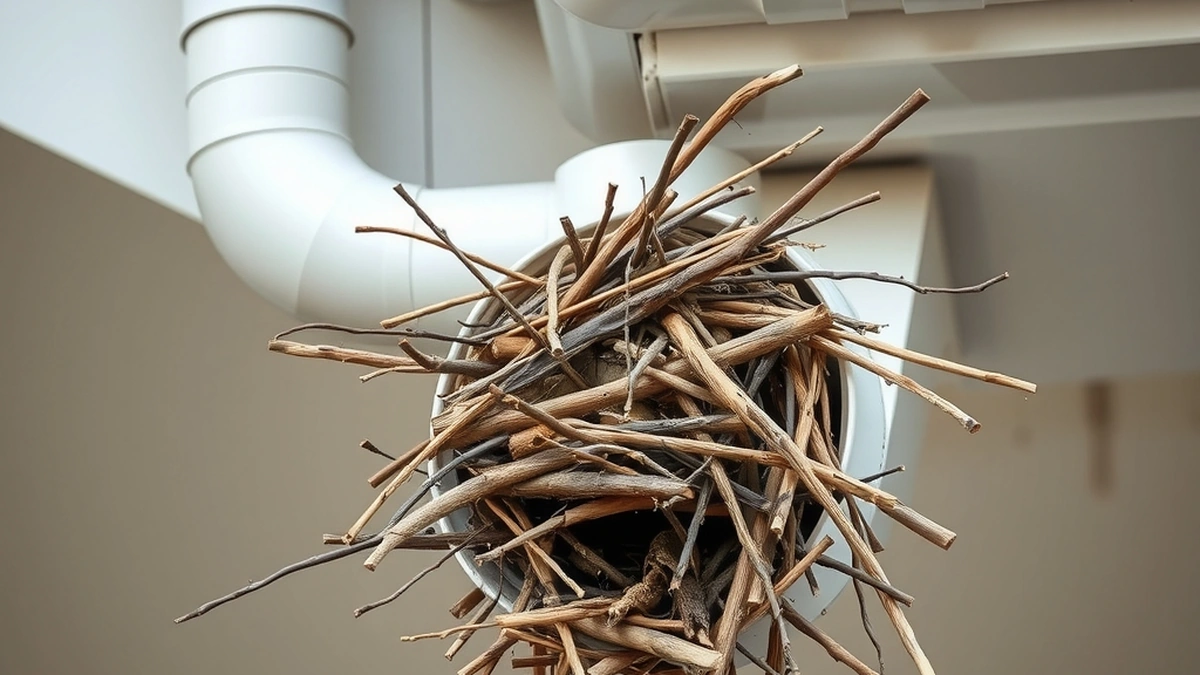
Before anything is measured, the outlet gets checked. A gutter holds roughly a gallon of water per 10 feet of 5-inch trough before it reaches the lip, so a half-blocked outlet shows up as overflow at the downstream end within minutes of a real storm.
- Remove the strainer or the guard section over the outlet.
- Reach into the outlet and pull out the mat of leaves and grit by hand.
- Flush the downspout from the top with a hose while a second person watches the bottom.
- If water backs up, feed a plumber’s snake down from the top or up from the bottom.
- Check that the pipe discharges at least 4 feet from the foundation and that the splash block is not buried.
That sequence solves most overflows for the price of a service call. If the gutter still overflows with a clear outlet, the problem is pitch, capacity, or both.
Re-pitching and re-hanging
A gutter has to fall toward its outlet at about 1 inch per 10 feet. Over a 30-foot run that is 3 inches of drop, and it is invisible from the ground, which is why so many runs are set flat or backwards.
Re-pitching means emptying the run, releasing the hangers, setting the new fall, and re-fastening. Expect $200 to $500 for a 20 to 40-foot section, most of it labour. Re-hanging a sag is similar work with new hardware and runs $200 to $450.
The arithmetic on a 30-foot sag is worth seeing. Ten hangers at $8 to $15 each is $80 to $150 in material, plus two to three hours of labour at $70 to $100, which lands at $290 to $450. That is the whole job. It is also why a quote of $1,200 for a single sag is a signal to get a second opinion.
Downspout capacity
A 2x3-inch downspout drains roughly 600 square feet of roof; a 3x4 drains about double. A 2,000-square-foot roof on a two-storey house may need four outlets, not two, and the failure shows as overflow in every heavy storm even with a clean gutter.
Adding a downspout costs $9 to $20 per linear foot installed, so a 12-foot run is $108 to $240, and a set of four is $400 to $1,000. Enlarging an existing outlet is cheaper than adding a run, but it only helps if the roof area over that run is the constraint.
When a guard is the wrong answer
A guard keeps debris out of the trough. It does not add pitch, capacity, or fall. If the overflow happens with a clean gutter, a $1,800 to $4,500 micro-mesh installation will reproduce the same overflow, with the added risk that a clogged panel makes it worse.
Buy the guard after the water path works. The order is: clear, pitch, capacity, then guard. Anyone selling the guard first is selling a product, not a fix. The cost comparison is in water overflowing: what a fix costs, and the maintenance that prevents the blockage in the first place is in gutter cleaning cost.
Diagnosing in six steps
- Watch the gutter in rain and note where the water leaves. One end, the middle, or the whole lip.
- Check the outlet and downspout for a blockage before touching anything else.
- Look for standing water an hour after rain stops. That is a pitch problem.
- Press down on the run between hangers. Movement over half an inch means a sag.
- Measure the roof area draining to each outlet and compare it with the pipe size.
- Inspect the fascia behind the gutter for soft wood or staining, which means the overflow has been running behind the gutter for a while.
The short version
Most overflowing gutters are fixed by clearing an outlet for $150 to $400. The next most common fix is re-pitching at $200 to $500, which solves the runs that were installed flat. Guards come last, after the water has somewhere to go. Repair pricing in more detail, including the $800 to $2,500 long-section case, is in gutter repair cost.
Frequently asked questions
Why does my gutter overflow in heavy rain?
Four causes cover almost every case: a blocked outlet, a run pitched the wrong way, a sag between hangers, or a downspout too small for the roof area it drains. Each has a different repair price.
How much does it cost to fix an overflowing gutter?
A clear-out is $150 to $400. Re-pitching runs $200 to $500, re-hanging a sag $200 to $450, and adding downspout capacity $400 to $1,000 for four runs. A long failed section can reach $2,500.
Can I fix gutter overflow myself?
The blockage is a DIY job if the gutter is on the first storey. Pitch and hanger work needs the run emptied, the fall set at 1 inch per 10 feet, and the fasteners replaced, which is a two-person job on a ladder.
Will gutter guards stop overflow?
Only if the overflow is caused by debris. A guard does nothing for a backwards-pitched run or an undersized downspout, and a clogged guard can cause the overflow it was bought to prevent.
How do I know if the pitch is wrong?
Water stands in the trough after rain stops, or the overflow always happens at the same end. Lay a level along the run; it should fall about 1 inch every 10 feet toward the outlet.
Does a bigger downspout fix overflow?
Sometimes. A 2x3 outlet handles roughly 600 square feet of roof; a 3x4 handles about double. If the roof area above the run exceeds that, adding an outlet is cheaper than replacing the pipe.
Sources
Some links are affiliate links.If you buy through them we may earn a commission at no extra cost to you. We do not accept payment for rankings. Read the full disclosure.